The Zen Feeling, Explained: What Ashwavana Zen Relax Actually Does When Your Day Gets Loud

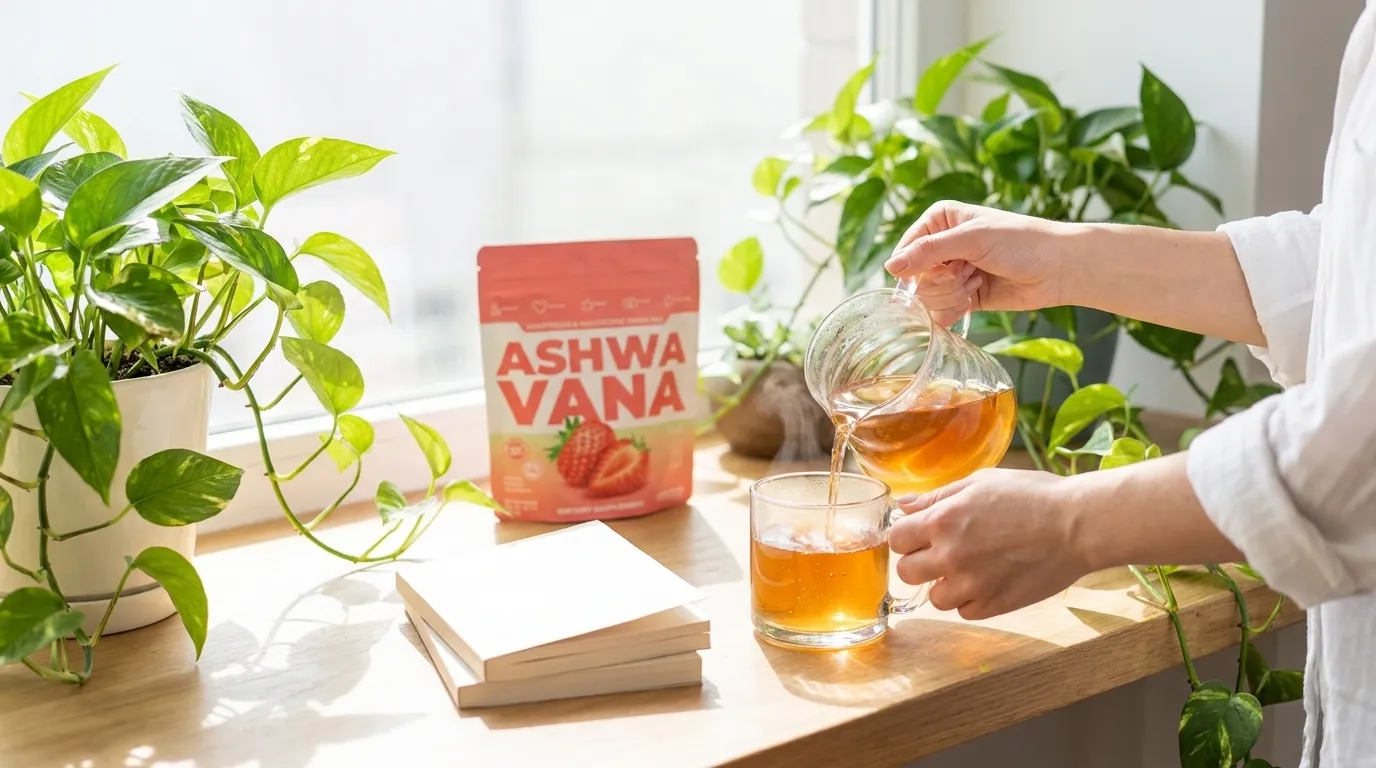
Last Tuesday I had three deadlines stacked on top of each other and a kid home with a cold. By 2 p.m. my shoulders were somewhere around my ears. I made a mug of Ashwavana Zen Relax, drank it slowly at the window while the water was still too hot to gulp, and about half an hour later noticed the specific thing I always notice: I wasn't calmer because the day got easier. The day was exactly as loud. I just stopped bracing against it.
That's the feeling people are chasing when they search "Ashwavana Zen Relax benefits," and it's a fair thing to want a straight answer on. So here's mine, as the dietitian who reads the studies on every ingredient before it goes in the pouch. Not hype — mechanisms. What's actually doing the work, and why the combination feels different from any single supplement.
First, what "the benefits" actually are
When I read through our own reviews, the same handful of phrases keep surfacing. People describe reduced stress and anxiety, a genuinely calm and relaxed "zen" feeling, sharper focus, clean energy without the jitter-crash cycle, better sleep, and a steadier mood. One customer put it more bluntly than I ever would:
"Anxiety is completely gone which I can't believe."Another wrote, "Super chill and zen. I feel relaxed and in a good mood no matter how stressful the day gets."
Those aren't separate, unrelated perks. They're what happens when you support the stress response from a few directions at once. Let me walk through how.
The two adaptogens doing the heavy lifting
Ashwagandha (Sensoril) — the baseline reset
The ashwagandha in Zen Relax is Sensoril, a standardized Withania somnifera extract drawn from both root and leaf. Its job is the slow, foundational one: it acts on the stress axis with GABAergic and serotonergic activity and helps lower circulating cortisol, the body's main stress hormone. In a clinical trial studying Sensoril specifically in people with generalized anxiety, and in a broader systematic review and meta-analysis on ashwagandha's effects on cortisol, stress and anxiety in adults, this is the through-line — a calmer stress-hormone rhythm over time.
Here's the honest caveat: ashwagandha is not a same-hour switch. It builds. The research framing across the field is consistent — it works on the HPA axis over weeks of consistent use, not minutes. Ashwagandha works as an adaptogenic herb that may help your body build long-term resilience by supporting healthy cortisol rhythms. So the deepest benefits show up when you drink it regularly, not once.
Rhodiola (RhodioPrime 6X) — the anti-fatigue piece
Rhodiola rosea is an adaptogen aimed at a slightly different problem: mental and physical fatigue. RhodioPrime 6X is a concentrated standardized extract, and in trials like the study on rhodiola for anxiety, stress and cognition, and a randomized controlled trial in nursing students during exam-level stress, it supports stress-related fatigue and mood while helping attention hold up under pressure. This is the ingredient I credit for the "focus" reviews — the ones like "I also have amazing focus and drive throughout the day." It keeps the calm from tipping into foggy.
Why it feels calm-but-alert (not sleepy)
This is the part I get asked about most, because most calming products make you want a nap. The answer is L-theanine, an amino acid from tea.
L-theanine promotes what researchers call "relaxed alertness" — a calm, focused mental state without drowsiness, which has made it popular for daytime stress management. Mechanically, it nudges up alpha brain-wave activity, the pattern linked to wakeful relaxation, and it lowers perceived stress and salivary cortisol. L-theanine has been clinically shown to promote an alert state of relaxation without drowsiness, within 30-60 minutes, as indicated by an increase in alpha brain waves. That's the AlphaWave L-theanine research and the study on L-theanine and cognitive function in healthy adults in a nutshell.
And because there's a little caffeine from the matcha in this blend, the pairing matters. L-theanine does not cancel caffeine — it modulates its effects, and the L-theanine plus caffeine combination is one of the most well-studied stacks, producing alert focus without the jittery side effects of caffeine alone. That's the mechanism behind the review that says, "Keeps me calm and energized no jittery feelings and no crashes." The theanine is riding shotgun with the caffeine, smoothing it out.
The supporting cast that quietly matters
The two adaptogens and the theanine are the headliners. But a few of the other ingredients earn their spot for reasons that are easy to overlook:
- Magnesium — an essential mineral for nervous-system regulation, and one many adults simply fall short on. Restoring it is associated with reduced stress, better mood, and improved sleep; it also helps the body absorb other nutrients. The trials here are the magnesium-and-B6-versus-magnesium-alone study in stressed adults with low magnesium, and the research on magnesium in depression.
- Vitamin D3 — the form that most effectively raises blood vitamin D. Low vitamin D tracks with low mood, and supplementation modestly reduces depressive symptoms, with the clearest benefit in people who are actually deficient or already low. It's not a mood switch for everyone — it's a fix for a common shortfall.
- Lemon balm — a traditional calming herb whose rosmarinic acid supports GABA activity. Clinical trials, including one in patients recovering from cardiac surgery, show it eases anxiety and improves sleep quality.
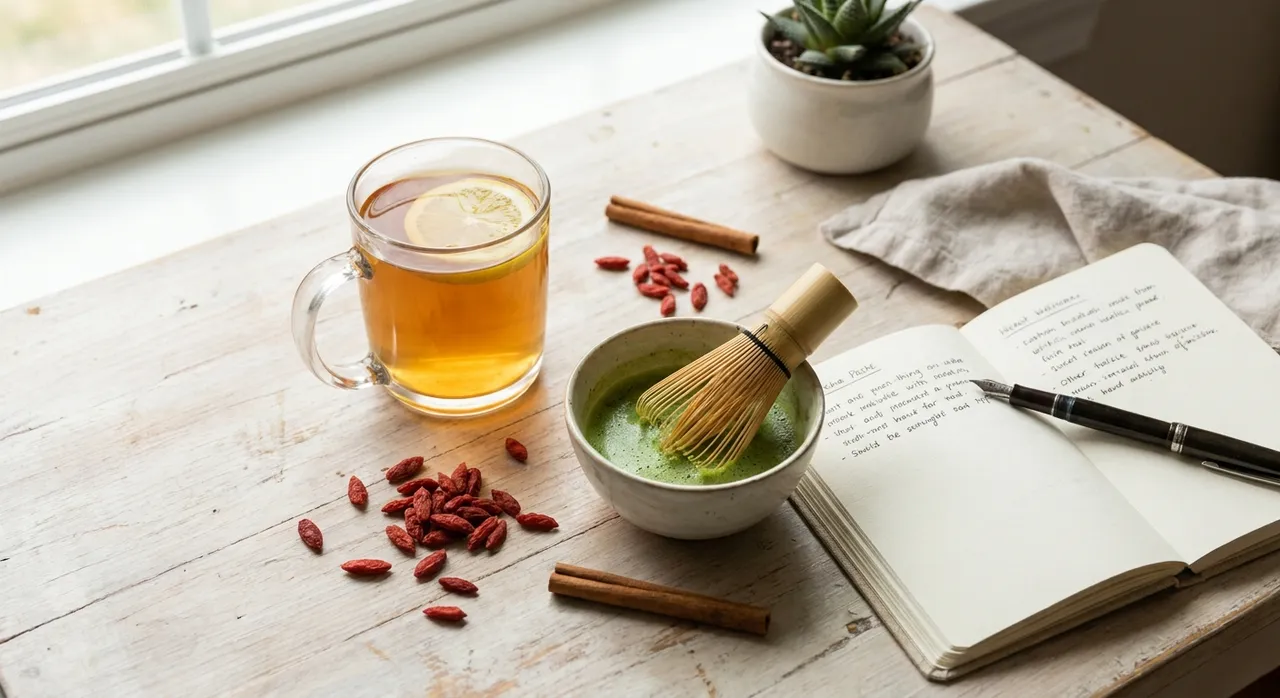
- Matcha — whole-leaf green tea rich in L-theanine and EGCG. Beyond the caffeine-balancing act, matcha itself has been shown to lower stress and modestly sharpen attention and memory in clinical trials.
- Turmeric and ginger — the anti-inflammatory pair. Curcumin lowers inflammatory and oxidative-stress pathways and, in meta-analyses, is linked to reduced anxiety and depressive symptoms; ginger's gingerols raise antioxidant capacity and lower markers like CRP, IL-6 and TNF-alpha.
- Beet root and grape seed extract — the blood-flow duo. Beet root's dietary nitrate converts to nitric oxide to relax blood vessels and lower blood pressure, while grape seed's proanthocyanidins improve vascular function and cerebral blood flow, with trials in older adults showing gains in processing speed and attention.
- Shiitake, chlorella, goji berry, pomegranate, cinnamon — the antioxidant and immune layer. Shiitake's beta-glucans, in a randomized dietary trial, improved markers of immune function and lowered inflammatory markers.
So how do the benefits add up?
Think of it as three timelines running at once. In the first 30 to 60 minutes, the L-theanine and matcha give you that alpha-wave, calm-alert focus — the reason one reviewer described "more focus and calmness to get rid of being overwhelmed." Underneath that, over weeks of regular use, the Sensoril ashwagandha and rhodiola are recalibrating your baseline stress response and fatigue. And in the background, the minerals, vitamin D, and anti-inflammatory roots are patching the everyday deficits that make stress feel worse than it needs to.
That layered design is also why so many people reach for it as a healthier alternative to a glass of wine at the end of a hard day. The functional-drink shift is real — searches for functional beverages are growing, with adaptogens and nootropics among the top trends driving change. Zen Relax fits that moment, minus the next-morning tax.
My honest take, dietitian hat firmly on: no drink erases a stressful week, and I'd distrust anything that promised to. What Zen Relax does — reliably, in my own daily testing — is turn down the volume enough that the week is workable. Or, as one review I keep coming back to puts it: "I feel SO zen, I'm in a better mood, and it's helping me sleep better too." That's the whole goal.
These statements have not been evaluated by the Food and Drug Administration. This product is not intended to diagnose, treat, cure, or prevent any disease. The studies referenced above describe the individual ingredients used in Ashwavana Zen Relax, not the finished product, and individual results vary. If you are pregnant, nursing, taking medication, or managing a health condition, talk with your healthcare provider before adding a new supplement.
Priya is a registered dietitian who reviews the science behind every ingredient we use. She spends her days turning clinical research into plain English.
Ready to try it for yourself?
Shop Superfoods Company