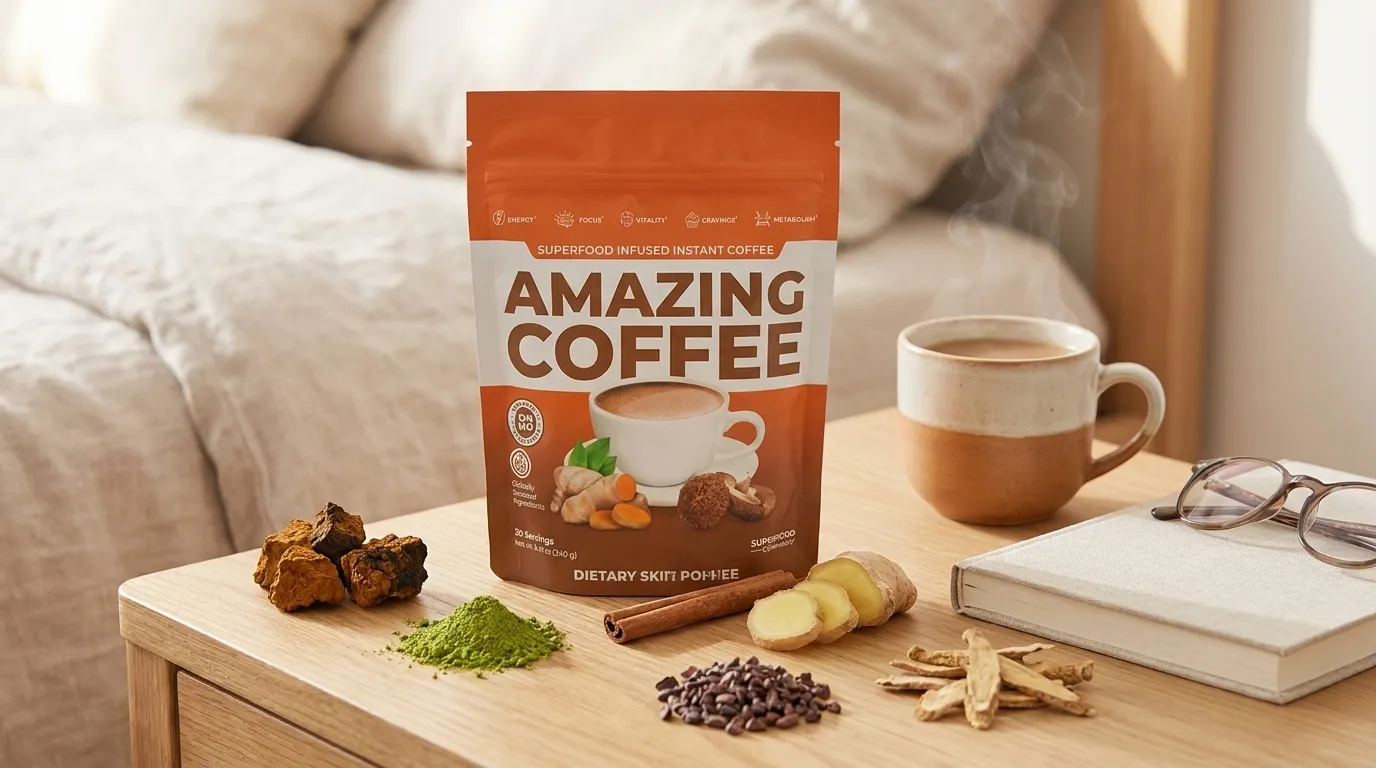
Why Your Amazing Coffee K-Cup Doesn't Wear Off Like Regular Coffee


The first time I really noticed it, I was standing in my bathroom at 6:40 a.m., toothbrush in one hand, mug in the other. I'd had the cup maybe twenty minutes earlier. What struck me wasn't a jolt — it was the absence of one. No buzzing hands, no racing thoughts. Just a quiet lifting of the fog, the kind where you suddenly remember the three things you meant to do before leaving the house.
As the dietitian who reads the studies behind everything we put in a cup, I get asked the same question constantly: why does this feel different from regular coffee? It's a fair question. So let me walk through what's actually happening, ingredient by ingredient, and where the honest caveats are.
Start with the caffeine — but not too much of it
There is real coffee in here. French Roast and Green Coffee both bring caffeine, and caffeine is the part that does the obvious work. Caffeine blocks adenosine receptors in the brain, reducing the perception of fatigue and increasing alertness, vigilance, reaction time and attention — that's from a broad review of caffeine's effects on cognitive, physical, and occupational performance, echoed in home-based web-cognition testing.
Here's the thing most people miss, though. The dose matters as much as the compound. Functional coffees like this one tend to land lower than a standard brewed cup, and that's by design. Mushroom coffee's lower caffeine, typically 40–75 mg per serving, delivers steady energy while adaptogens work to support mental clarity. A moderate dose gives you the lift without pushing you into the shaky, over-caffeinated zone.
That's the mechanism behind what our customers keep telling us in their own words — "it doesn't give me the jitters," "does not give me that jittering feeling," "more energy for a longer period of time." One reviewer summed up the whole appeal of a gentler curve: "stopped needing naps during the day."
Why the edge feels smoother: matcha's L-theanine
A big reason a cup can feel calm-but-alert is Matcha. Mushroom coffee contains roughly half the caffeine of regular coffee, providing a gentle, sustained energy boost instead of a sudden spike, so you stay alert without feeling jittery or anxious. But the smoothing effect isn't just about less caffeine — it's about what's paired with it.
Matcha is a concentrated green tea rich in L-theanine, an amino acid studied for promoting a relaxed-yet-alert state. In work like the systematic review on tea, L-theanine, and L-theanine-plus-caffeine on cognition, sleep, and mood, that combination is where the magic sits: the theanine takes the sharp corners off the stimulant while attention holds. It's the difference between being wired and being dialed in.
The part people email me about: appetite and cravings
If I had to name the benefit that shows up most in our reviews, it's this one. "Most importantly, it suppresses my hunger." "Curbed my appetite." "My muffin top is shrinking daily." I always add a caveat here — no cup of coffee melts fat on its own — but there is real mechanism worth explaining.
The Green Coffee (unroasted beans) is the key. Green coffee is rich in chlorogenic acids, polyphenols studied in a systematic review and meta-analysis of randomized trials for supporting modest body-weight reduction, plausibly by slowing glucose absorption and nudging fat metabolism. Green Tea adds to that story: its catechins, notably EGCG, especially alongside caffeine, modestly raise energy expenditure and fat oxidation — that's the throughline across the catechin and EGCG meta-analyses.
Then there's Cinnamon, quietly doing steadying work. Cinnamon polyphenols may improve insulin sensitivity and slow gastric emptying, supporting more stable post-meal blood glucose per the dose-response meta-analysis on glycemic control. Steadier blood sugar tends to mean fewer of those mid-afternoon "I need something sweet right now" spikes. It's modest. It's real. It's not a miracle — it's a nudge in the right direction, repeated daily.
Focus and mental clarity, from more than one direction
Several ingredients pull toward the "liquid brain" effect one customer described (my favorite phrase in our whole inbox: "This is my dessert and my liquid brain during the day.").
- Ginseng — an adaptogen whose ginsenosides are studied for reducing mental fatigue and supporting working memory, per the randomized antifatigue trial on Panax ginseng.
- Maca Root — a Peruvian adaptogen studied for improving self-reported mood and energy in a randomized, double-blind, placebo-controlled study on black and red maca.
- Cocoa — cocoa flavanols improve blood-vessel function and cerebral blood flow, linked to better mood and reduced mental fatigue in the CoCoA study and related trials. (It's also why the cup tastes like a mocha, which I'm not mad about.)
Put together, that's the "brain fog lift" people mention: "I did feel some brain fog lift," "given me extra energy." No single ingredient is a nootropic silver bullet. The point is the stacking.
The endurance and immune supporting cast
Some ingredients here won't announce themselves in the first sip, but they're doing background work:
- Cordyceps — a functional mushroom studied for improving oxygen utilization (VO2max) and tolerance to high-intensity exercise, which can translate to less perceived fatigue, per the Cordyceps militaris supplementation trial.
- Shiitake — rich in beta-glucans including lentinan; a randomized dietary intervention in healthy young adults found daily intake improved immune markers and lowered CRP.
- Chaga — a polyphenol- and polysaccharide-rich mushroom with antioxidant and immunomodulatory activity, though I'll be straight with you: that evidence is mostly lab and animal models so far.
- Turmeric & Ginger — curcumin down-regulates inflammatory signaling (NF-kB), lowering markers like CRP, IL-6 and TNF-alpha, while ginger's gingerols and shogaols add antioxidant, anti-inflammatory activity. These are the "gentle on the stomach" contributors that make this easier to drink than a hard black coffee for a lot of people.
So how do you actually get the benefits?
A few honest, practical notes after brewing hundreds of these:
- Brew on the standard 8 oz setting first. If it tastes too strong, go to 10 oz — the mocha-cinnamon note holds up well diluted.
- Have it with or after a little food if appetite control is your goal. The blood-sugar steadying works best when it's not landing on a totally empty stomach.
- Give it two to three weeks. Almost every benefit above — weight support, mood, immune markers — comes from consistent daily intake in the studies, not a single cup.
- Mind your timing. With that moderate caffeine, an early-afternoon cup is usually fine; a 7 p.m. one might not be.
If you already bought a box, that's genuinely how I'd use it. If you're still deciding, the short version is: you're getting real coffee's alertness, dosed on the gentler side, wrapped in a blend built to smooth the edges and support the slower stuff. You can grab it here — Amazing Coffee K-Cups — and I'd start with the morning cup before your usual brew and see how the first few days feel.

The cup that lifts your fog at 6:40 a.m. and doesn't leave you crashing at 10 — that's not magic. It's a handful of well-studied ingredients doing modest things in the same direction. I'll take modest and consistent over dramatic and short-lived every time.
These statements have not been evaluated by the Food and Drug Administration. This product is not intended to diagnose, treat, cure, or prevent any disease. The research referenced above describes individual ingredients and their studied effects, not the finished Amazing Coffee K-Cups product, and individual results will vary. If you are pregnant, nursing, taking medication, or managing a health condition, talk with your healthcare provider before adding a new functional coffee to your routine.
Priya is a registered dietitian who reviews the science behind every ingredient we use. She spends her days turning clinical research into plain English.
Ready to try it for yourself?
Shop Superfoods Company