I Read the Studies on Every Ingredient in Zen Relax. Here's What Actually Earns Its Place.

The first thing I do with any formula — before I taste it, before I read a single review — is line up the ingredients against the actual studies and cross off anything that's just there for the label. I did that with this blend on a Tuesday morning, coffee going cold, a stack of meta-analyses open on my laptop. I expected to cross off a lot. I didn't.
So this isn't a hype piece. It's the version of the breakdown I'd give a friend who texted me "does this thing actually work?" I'll tell you where the evidence is strong, where it's more modest, and what the ingredient does in your body — because the Ashwavana Zen Relax benefits people describe in reviews line up more closely with the research than most drinks in this category.
First, why "adaptogen drinks" are having a moment
There's a real shift happening. A lot of people want the wind-down ritual of a drink without the alcohol, and formulas built around herbs and mushrooms have filled that gap. As one health system's write-up put it, these drinks are packed with certain supplements and superfoods known for their stress-reducing and energy-boosting properties, often touted as natural solutions to stress and fatigue. Adaptogenic drinks — natural, uplifting beverages — are taking the health world by storm. The category is popular; the question is whether a given blend backs the trend with real doses of real actives. That's the part I care about.
The honest caveat up front: most of the human trials below test individual ingredients, not this finished drink. So I can tell you what each part is shown to do. I can't promise you a specific outcome. Bodies differ.

The stress axis: ashwagandha (Sensoril) does the heavy lifting
If one ingredient anchors this formula, it's ashwagandha — specifically Sensoril, a standardized Withania somnifera extract from root and leaf. Mechanistically it acts on the stress axis with GABAergic and serotonergic activity and lowers circulating cortisol, your body's main stress hormone. That's not a small claim, so here's the evidence behind it.
A 2024 systematic review and meta-analysis found that across randomized trials, ashwagandha produced a statistically significant reduction of cortisol levels, the perceived stress (PSS) scale, and the HAM-A anxiety scale — though, in the interest of honesty, it showed no statistically significant improvement in participants' quality of life. A separate meta-analysis of nine studies covering 558 patients reported that ashwagandha significantly reduced stress, anxiety, and cortisol levels compared to placebo, with decreased perceived stress, anxiety, and serum cortisol. (Those studies are echoed in the two Sensoril-relevant papers on generalized anxiety and the cortisol/stress meta-analysis.)
Translated: this is the ingredient that most plausibly explains the review I keep re-reading —
"Anxiety is completely gone which I can't believe."I'd temper "completely gone" as one person's experience, not a guarantee. But a measurable drop in cortisol and anxiety scores is exactly the kind of shift ashwagandha is built to produce.
Calm but alert: L-theanine and matcha
Here's the mechanism I find most elegant. L-theanine is an amino acid from tea that nudges up alpha brain-wave activity — the pattern tied to wakeful relaxation. One review noted that a study found 200 mg of L-theanine increased alpha-wave generation within 45 minutes, improving attention during demanding cognitive tasks while lowering self-reported tension. A broader science review adds the caveats: some studies suggest L-theanine may increase alpha waves associated with relaxation and selective attention, reduce stress and anxiety, and improve sleep quality, though findings are often inconsistent. Inconsistent is a word I respect — it means the effect is real but not universal.
The key detail is what happens when theanine meets caffeine. That same review notes that when combined with caffeine, L-theanine has been studied for cognitive benefits. This is the pharmacology behind "energy without the crash": the matcha in the blend brings a gentle dose of caffeine plus its own theanine and EGCG, and the theanine smooths the caffeine's edges. The supporting research here is the AlphaWave L-theanine trial in moderately stressed adults and the systematic review of tea, theanine and caffeine on cognition, sleep and mood.
This is the state one reviewer nailed:
"Keeps me calm and energized, no jittery feelings and no crashes."That's not marketing magic — that's what an alpha-wave shift plus a theanine-buffered caffeine dose feels like.
The supporting cast that earns its spot
A few ingredients aren't headliners but do real, mechanism-backed work:
- Rhodiola (RhodioPrime 6X) — an adaptogen for stress-related fatigue that can sharpen attention during demanding stretches, per trials like the Rhodiola nursing-student fatigue RCT and the anxiety/stress/cognition study. It's why "focus" and "drive" show up so often in reviews: "I also have amazing focus and drive throughout the day."
- Magnesium — an essential mineral in nervous-system regulation that many adults fall short on. A meta-analysis on magnesium and anxiety/sleep reflects the growing clinical interest here, and other work links restoring magnesium to lower cortisol, better mood and improved sleep. Bonus: it helps the body absorb other nutrients.
- Lemon balm — a calming herb whose rosmarinic acid supports GABA activity; clinical trials show reduced anxiety and better sleep quality (the Melissa officinalis meta-analysis and the post-surgery sleep RCT).
- Vitamin D3 — the form that most effectively raises blood vitamin D; supplementation modestly helps mood, with the clearest benefit in people who start out deficient. Not a mood switch — a fill-the-gap nutrient.
Sleep, mood, and the "zen" people keep describing
The magnesium and lemon balm story feeds directly into sleep. It's worth noting the evidence here is developing rather than settled — one crossover pilot trial specifically set out to examine magnesium's effect on sleep quality and mood in adults with nonclinical insomnia symptoms. Pair that with lemon balm's sleep data and ashwagandha's cortisol drop, and you get a plausible route to the review that made me smile:
"I feel SO zen, I'm in a better mood, and it's helping me sleep better too."
Another wrote, "Super chill and zen. I feel relaxed and in a good mood no matter how stressful the day gets." The word "zen" isn't a measurable endpoint. But "lower cortisol + more alpha waves + adequate magnesium" is a reasonable biochemical translation of it.
The extras: turmeric, ginger, beet root, and the antioxidants
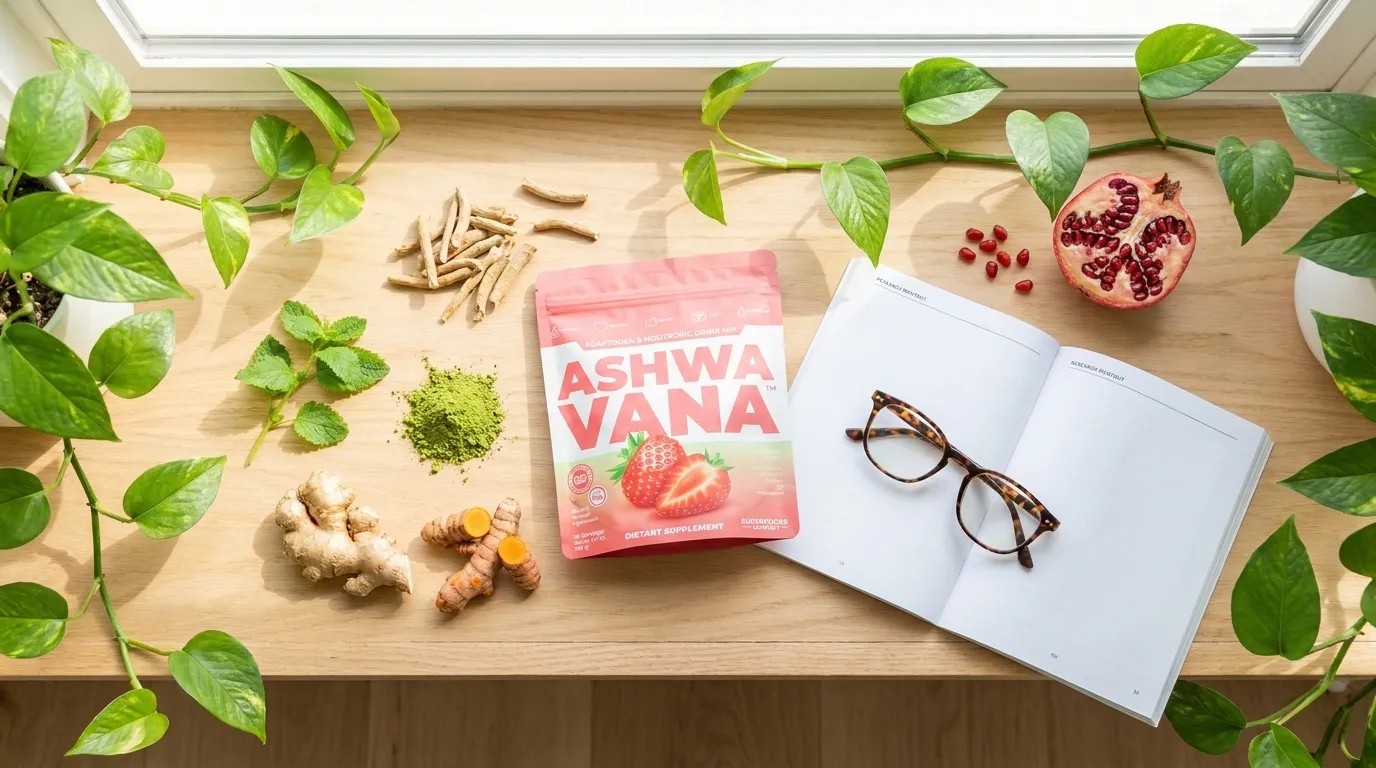
The rest of the blend leans on inflammation and blood flow — quieter benefits that add up. Turmeric's curcumin lowers inflammatory and oxidative-stress pathways and, in meta-analyses, is linked to reduced anxiety and depressive symptoms. Ginger's gingerols lower markers like CRP, IL-6 and TNF-alpha. Beet root is nitrate-rich, converting to nitric oxide that relaxes blood vessels and supports healthy blood pressure and blood flow. Grape seed extract (OPCs) supports cerebral blood flow and attention, shiitake's beta-glucans support immune function, and goji, pomegranate, chlorella and cinnamon round it out with antioxidants. None of these are "calm" ingredients on their own — they're the reason this reads as a superfood blend rather than a single-note stress pill.
My honest verdict
I went in expecting to cross things off. Instead, the actives that matter most for stress — Sensoril ashwagandha, L-theanine, magnesium, lemon balm — are the ones with the strongest human data, and the "no crash" claim has a genuine pharmacological basis rather than a slogan behind it. If you already drink it, that's the science under the feeling. If you're deciding, know that the evidence is promising but individual, and give any adaptogen a couple of weeks. As one reviewer put it plainly: "more focus and calmness to get rid of being overwhelmed." That's a reasonable thing to hope for here.
These statements have not been evaluated by the Food and Drug Administration. This product is not intended to diagnose, treat, cure, or prevent any disease. The research described above studies individual ingredients, not this finished product, and individual results will vary. If you're pregnant, nursing, taking medication, or managing a health condition, talk with your healthcare provider before adding a new supplement.
Priya is a registered dietitian who reviews the science behind every ingredient we use. She spends her days turning clinical research into plain English.
Ready to try it for yourself?
Shop Superfoods Company