What the Research Actually Says About Creatine Prime+ Benefits

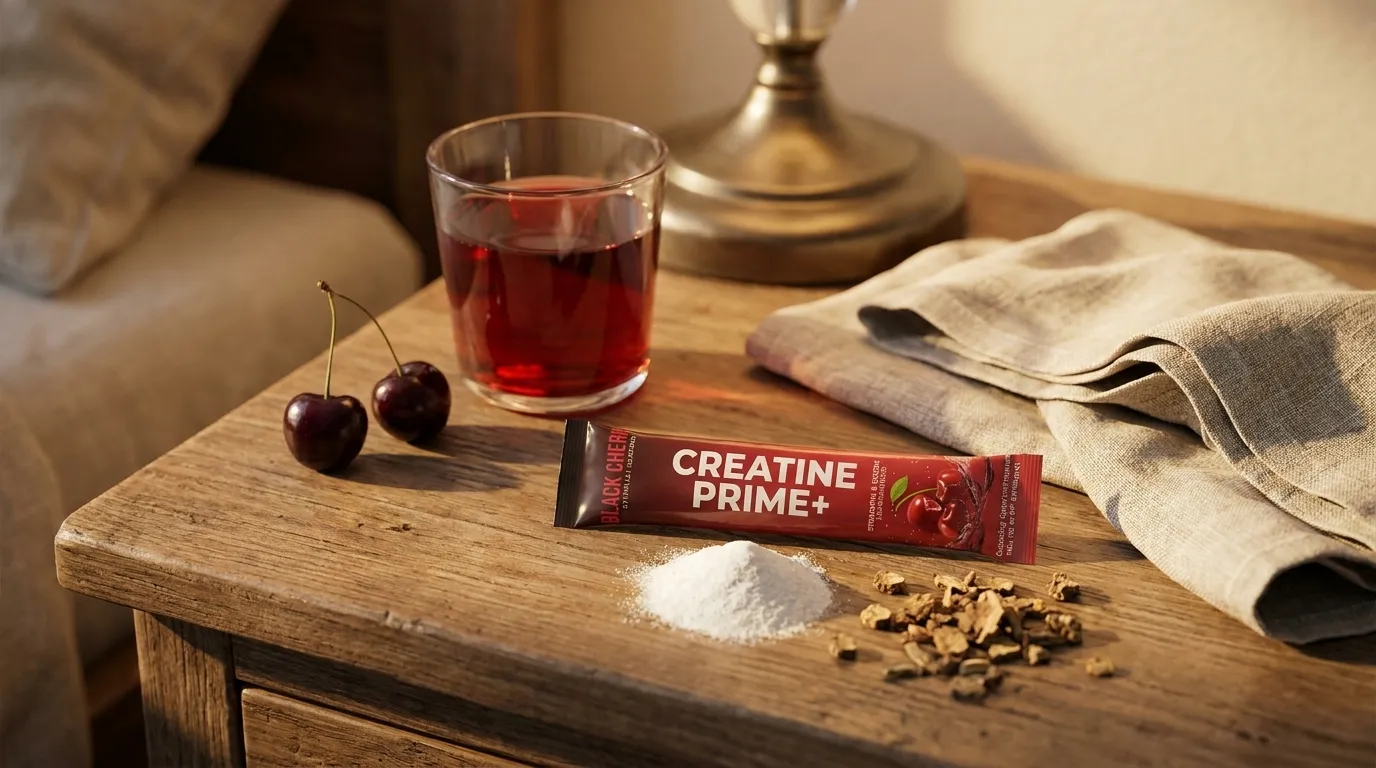
Last Tuesday I had back-to-back calls from 9 to 1, a toddler who'd decided 5 a.m. was morning, and a review deadline I'd been dreading. By 3 p.m. I'd normally be reaching for a third coffee and feeling the familiar wobble that comes with it. Instead I had a stick pack of Black Cherry in a glass of cold water, and I just… kept going. Not wired. Not buzzing. Just steady.
I'm a dietitian, so my first instinct is to be suspicious of anything that makes me feel good. "Steady" is subjective. It could be placebo. So I did what I do with every ingredient we put in a product — I went back to the studies and asked a plainer question: what can two ingredients, creatine monohydrate and rhodiola, actually do, and what are they just marketed to do?
Here's my honest read. If you've already got Creatine Prime+ in your drawer, this is what you're actually getting. If you're on the fence, this is where the evidence is strong and where it's still modest.
The two ingredients, and why both are in here
Creatine Prime+ is deliberately short: creatine monohydrate and RhodioPrime 6x, a standardized rhodiola extract. That's it. No caffeine, no proprietary "blend" hiding trace doses of a dozen things. Two ingredients, each doing a specific job.
The reason they're paired is that they work on the same problem — your energy and focus over a long, demanding day — from two different angles. Creatine handles the cellular hardware. Rhodiola handles the stress response. Let me take them one at a time.
Creatine: the cell's rapid recharge system
Most people file creatine under "gym bro supplement," which undersells it. At the cellular level, creatine's job is to help regenerate ATP — the molecule your cells spend when they do work. It keeps the phosphocreatine pool topped up so muscles (and neurons) can recharge ATP faster during effort.
That matters in two places I care about.
Muscle and strength — especially as we age
This is the best-established benefit. By increasing the muscle's phosphocreatine pool, creatine lets muscle cells regenerate ATP faster during a hard set. Combined with everyday activity or resistance training, that translates to greater gains in strength and lean tissue. Two reviews I keep coming back to — the meta-analysis on creatine combined with resistance training in older females, and the broader meta-analysis on creatine ingestion strategies for lean tissue and strength in older adults — both point the same direction: the effect is real, it's bigger when you're actually moving, and it helps offset the muscle and strength loss that accelerates for women after midlife.
Caveat worth saying out loud: creatine is not a shortcut around training. It's a multiplier on effort you're already putting in. No lifting, no bowl of groceries carried up the stairs, much smaller payoff.
The brain angle
This is the part that's gotten more interesting in the last few years. Your brain is metabolically greedy — it burns a huge share of your energy for its size. Raising brain creatine stores gives neurons a larger energy buffer for demanding tasks like memory and attention. A systematic review on creatine and cognition in older adults, and a separate meta-analysis on creatine and memory in healthy people, both found measurable support for memory and attention, with the signal strongest when the brain is under some kind of load — stress, sleep deprivation, or aging, when natural creatine levels and brain energy decline.
I'll be precise here: this is "supports memory and attention," not "makes you smarter." The effects are modest and most noticeable when you're depleted. Which, honestly, describes a lot of my weeks.
For women through perimenopause and menopause
One reason I pushed for creatine specifically is the emerging work on women's health. Hormonal shifts in peri- and post-menopause are linked to lower brain energy and that infamous "brain fog." The CONCRET-MENOPA randomized trial looked at creatine supplementation in perimenopausal and menopausal women and measured brain creatine alongside cognitive outcomes, and the review "Creatine in women's health" traces the thread from menstruation through pregnancy to menopause. The through-line: supplemental creatine can raise frontal-lobe creatine and support faster reaction time and steadier mood during that transition.

Rhodiola: the stress-adaptation half
If creatine is the hardware, rhodiola is the software that helps you handle a hard day without crashing. It's an adaptogen — its actives, rosavins and salidroside, modulate your stress response and central neurotransmission.
The study I find most convincing is the double-blind crossover on a standardized extract (SHR-5) given to physicians on night duty — a brutal, real-world stress test. In demanding, fatiguing conditions, rhodiola improved mental performance: concentration, short-term memory, speed of perception, and reduced the feeling of mental fatigue. A broader systematic review on rhodiola for physical and mental fatigue reaches a similar, cautious conclusion.
There's also work on the deeper end of the stress spectrum. An open-label trial in people with prolonged or chronic fatigue, and a review on rhodiola's effects on anxiety, stress, and mood symptoms, report improvements in perceived stress and exhaustion. Open-label trials are weaker evidence than double-blind ones — I won't pretend otherwise — but the pattern across study types is consistent enough that I'm comfortable with it.
Why pair them instead of just taking creatine?
Because they cover each other's gaps. Creatine gives your cells a bigger energy buffer; rhodiola helps your nervous system spend that energy more evenly under stress. One is a physical substrate, the other is an adaptogenic modulator. Together they aim at the thing most of my clients actually complain about — not "I can't lift heavy," but "I run out of gas and focus by mid-afternoon."
And crucially, none of this runs on stimulants. Creatine keeps phosphocreatine topped up for a steady energy buffer in muscle and brain — no caffeine, no jitters, no crash. The International Society of Sports Nutrition's position stand calls creatine monohydrate the most extensively studied form and well tolerated long-term, which is exactly why we use the plain monohydrate and not a fancier, less-studied variant.
What our own customers describe
The research tells you the mechanism. What people feel is a little softer, and I read our reviews the way I'd read anecdotes — interesting, not proof. But the patterns line up with the science in a way I find reassuring.
"I just feel steadier and more focused lately."
"I've noticed my recovery feels smoother after workouts."
Those two are the most common themes — smoother post-workout recovery and steadier focus through a busy day. Another one I appreciate for its honesty:
"It's been a small but real help for me."
That's the right expectation, frankly. Small but real. Creatine and rhodiola aren't a switch you flip; they're a slow accumulation. Creatine stores build over a few weeks, and adaptogens tend to show up gradually too.
The unglamorous reasons it actually sticks
A supplement only works if you take it, and this is where the practical stuff matters more than people admit. The format is single-serve stick packs, which removes the two friction points that killed my last creatine tub: scooping and clumping.
- It mixes instantly. No chalky grit at the bottom of the glass. As one reviewer put it, "This mixes instantly and tastes better than I expected."
- The Black Cherry is drinkable. "Easy to drink and not overly sweet" matches my experience — it's not candy.
- No measuring. "No mess, no measuring, which I appreciate." One pack, one glass of water, done.
If you want a simple rhythm: one stick pack in 8–10 oz of cold water, once a day, timing is flexible. Consistency beats timing with creatine. I take mine mid-morning because that's when I'll actually remember.
My honest bottom line
The strongest evidence is for strength and lean tissue when paired with activity, and for cognitive support when you're under load — stress, aging, hormonal transition. The rhodiola evidence for mental fatigue and stress resilience is good but a notch less bulletproof. And the "steady energy, no crash" piece is well supported by the mechanism and by decades of safety data on creatine monohydrate.
If you bought Creatine Prime+ hoping for a dramatic jolt, recalibrate — that's not what this is. If you wanted something that quietly helps you handle busy days a little better, the science and our reviews both point that way. "Small but real" is a claim I can stand behind as a dietitian.
These statements have not been evaluated by the Food and Drug Administration. This product is not intended to diagnose, treat, cure, or prevent any disease. The studies referenced here examine individual ingredients — creatine monohydrate and rhodiola rosea — and not the finished Creatine Prime+ product. Individual results vary. Talk with your healthcare provider before starting any supplement, especially if you are pregnant, nursing, taking medication, or managing a health condition.
Priya is a registered dietitian who reviews the science behind every ingredient we use. She spends her days turning clinical research into plain English.
Ready to try it for yourself?
Shop Superfoods Company