What MCT Oil Actually Does to Your Coffee (A Dietitian's Honest Breakdown)

The first time I put MCT oil in my coffee, I did it wrong. It was 6:10 a.m., I stirred a tablespoon of plain oil into a hot mug, and thirty seconds later there was an oil slick floating on top like a tiny lagoon. I drank it anyway. It tasted like buttered disappointment. But the reason I kept experimenting — and eventually built a creamer around it — is that the science underneath that greasy first attempt is genuinely interesting, and mostly holds up.
So let's do this the way I do everything on this blog: I'll tell you what MCT oil actually does in your cup, where the research is strong, where it's thin, and how to make a version that doesn't separate. I read the studies for a living. I'll also tell you when the internet is overselling it.
First, what MCT oil even is
MCT stands for medium-chain triglycerides — a category of fat with a shorter carbon chain than the long-chain fats in, say, olive oil or a steak. MCTs are health-promoting fatty acids that are rapidly converted into ketones, and most MCT oils are derived from coconut oil, which contains high concentrations of MCTs such as caprylic acid and capric acid. That "shorter chain" detail is the whole story, so hang onto it.
The reason it matters: chain length changes how your body handles the fat. MCTs have a shorter carbon chain than most other fatty acids, and your liver can metabolize them quickly, which is linked to various metabolic advantages. Regular dietary fat takes a long, scenic route through your lymphatic system. MCTs cut the line.

The energy claim — this one's real, with a nuance
Here's the pathway everyone talks about. Ketones are an alternative fuel source to glucose that your body can use immediately for energy, and because the body sees MCTs as an immediate fuel source, they are far less likely to be stored as body fat compared to other types of oil. That's the mechanism behind the "clean energy" phrasing you see everywhere.
But the part I actually care about — as someone who has felt the 10 a.m. coffee crash more times than I'd like to admit — is what the fat does to the caffeine. When you drink black coffee, the caffeine is absorbed almost instantly, which leads to a sharp spike in energy followed by a sharp drop, often called the caffeine crash. Add fat and the curve flattens. The fat slows down the digestion of the caffeine, which leads to a more stable, prolonged release of energy — instead of a 45-minute spike, you get several hours of steadier output.
How fast does the fuel actually show up? Faster than you'd guess. Adding about 5 ml of C8 MCT oil to coffee elevates plasma BHB (a ketone) within 15 to 30 minutes without triggering an insulin spike. That's roughly the time it takes me to answer my first three emails.
This is also why our reviewers keep using the word "sustained." One wrote something that made me laugh because it's so definitive:
"I don't ever want to go back to regular coffee."Another:
"This creamer is seriously a life hack."Anecdotes aren't studies. But when the mechanism and the reviews point the same direction, I pay attention.
Focus and mental clarity — plausible, not proven-in-everyone
The brain runs mostly on glucose, but it will happily burn ketones when they're around. Under normal eating conditions ketones supply only about 3% of your brain's energy needs, but drinking MCT oil on an empty stomach nudges ketone production higher, and ketones cross the blood-brain barrier through dedicated transport channels, which is why some people report feeling more mentally alert.
I want to be square with you here, because this is where marketing gets ahead of the evidence. The mental clarity many people describe is plausible given that ketones provide direct fuel to the brain, though controlled studies on cognitive performance in healthy adults are limited. The clinical work on ketones and cognition — studies like Effects of beta-hydroxybutyrate on cognition in memory-impaired adults — is more compelling in metabolically stressed populations than in a healthy 32-year-old who just wants to focus during a Monday standup. So: real mechanism, honest asterisk.
Appetite and weight — helpful lever, not a magic wand
This is the benefit our reviews mention most, and it's also the one I'm most careful about. On the supportive side, MCT oil is thought to increase satiety or fullness, reducing snacking and overeating, and MCTs are known to support ketosis, a process by which the body burns fat instead of carbs for energy. There's clinical backing for the metabolic angle too — trials like Medium-chain triglycerides increase energy expenditure and decrease adiposity in overweight men found MCTs behave differently than long-chain fats when it comes to fat storage and energy burn.
Now the caveat, because you deserve it. A systematic review in Critical Reviews in Food Science and Nutrition found MCTs don't appear to work through the usual appetite hormones — long-chain fats actually trigger stronger fullness signals — and while many people report feeling less hungry, that's likely partly because they're consuming 120-plus calories of fat that would otherwise be absent from a black cup. Read that twice. MCT coffee can genuinely help you eat less at your next meal, but it is not a zero-consequence add-on. What it's not is a weight-loss tool on its own — you're adding over 100 calories of fat to a drink that had none.
That honesty said — the real-world results people write in are hard to ignore:
"I have lost 12# since I have been using your creamer, by the way I am 80 years young!!!"And:
"I've lost 29lbs since using this."The pattern I see is that it works as an appetite and craving lever — one of the most common reasons people add MCTs to morning coffee is to manage hunger — that helps them naturally eat less through the day. Reviewers put it plainly: it "helps with appetite" and "I don't get that much hungry."
The cholesterol angle worth knowing
One finding I think gets under-discussed: in a study of 24 overweight men following a diet with 40% of energy from fat as either MCT oil or olive oil, LDL cholesterol decreased by nearly 14% in the MCT group, while olive oil produced no statistically significant change. That aligns with the research we lean on, like Dietary medium-chain triacylglycerols suppress accumulation of body fat in a double-blind, controlled trial in healthy men and women. It's one dataset, not a promise — but it's a nice bonus for a fat you're drinking daily anyway.
Why our version isn't just MCT
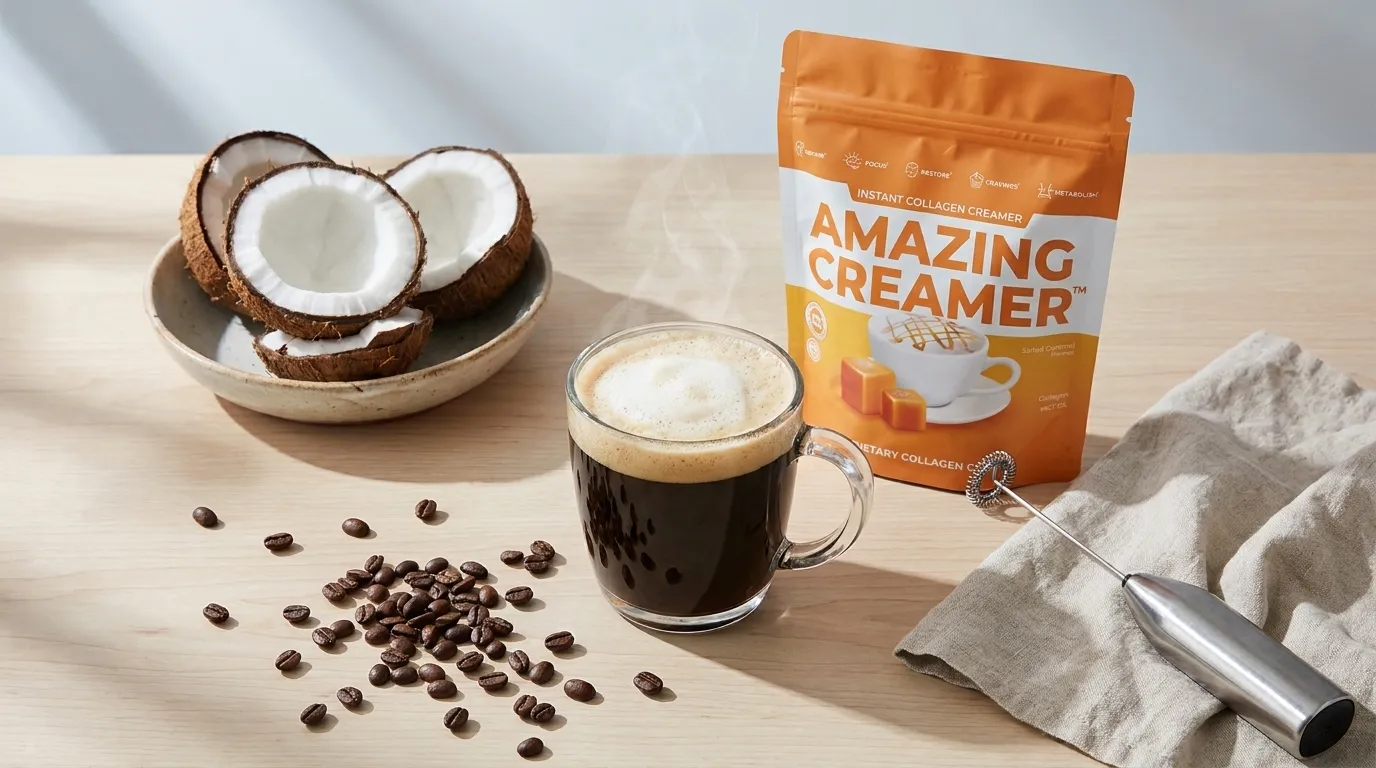
Most MCT coffee content stops at the oil. Amazing Creamer is three ingredients on purpose: MCT oil, collagen, and hyaluronic acid. The MCT does everything above. The other two are there because your morning coffee is the most reliable habit you have — so it's the best place to stack ingredients you'd otherwise forget.
- Collagen brings amino acids for skin, joints, hair, and nails. The research here is genuinely solid — studies like Oral supplementation of specific collagen peptides has beneficial effects on human skin physiology and 24-Week study on the use of collagen hydrolysate as a dietary supplement in athletes with activity-related joint pain back the skin-elasticity and joint-comfort claims. Our reviewers feel the joint piece acutely — one wrote, "When I stop using it, my joint pain returns almost immediately."
- Hyaluronic acid is the hydration player. It's naturally in your synovial fluid and skin, and it can hold up to a remarkable amount of water for its weight — supporting skin hydration and joint cushioning, per reviews like Oral hyaluronic acid supplementation improves skin hydration and elasticity.
So while the oil is doing the energy work, the other two are quietly doing the long-game work. That combination is why we keep hearing lines like, "My only regret is not trying it sooner!"

How to actually make it (so it doesn't separate)
My original oil-slick problem had one fix: emulsify. You have to blend or froth, because oil and water won't mix on their own. Mechanical blending is required for stable oil-water mixing. Here's the base recipe I use most mornings.
Steady-Morning MCT Coffee
- Brew 1 cup (8–10 oz) of hot coffee as usual.
- Add 1 scoop of Amazing Creamer (or, if starting with plain oil, begin with 1 teaspoon of MCT and work up to 1 tablespoon — see the dosing note below).
- Blend on high for 20 to 30 seconds until the mixture is frothy, or use a handheld milk frother for the same 20–30 seconds.
- Optional: a dash of cinnamon or a few drops of vanilla. Serve immediately — it separates as it cools.
Dosing note, because this matters: Most people find that 1 to 2 tablespoons of MCT per day is the sweet spot for focus and satiety. But do not start there. A starting dose of about 5 ml prevents GI discomfort. If you go too hard too fast, MCT oil can cause an urgent bathroom conversation. Ask me how I know. Start low, ramp over a week or two.
My honest bottom line
MCT oil coffee is not hype-proof, but the core of it is real: quicker energy that doesn't spike-and-crash, plausible focus support, and a genuine appetite lever — as long as you count the calories it adds and don't expect it to out-run your diet. The version I stand behind adds collagen and hyaluronic acid so the same daily cup does more than caffeine ever could. One reviewer summed up my whole feeling about it: "Never going back to regular creamers again!!!" Neither am I.
These statements have not been evaluated by the Food and Drug Administration. The studies referenced above describe individual ingredients — MCT oil, collagen, and hyaluronic acid — and not the finished Amazing Creamer product. Amazing Creamer is not intended to diagnose, treat, cure, or prevent any disease. Individual results vary, and you should talk with your healthcare provider before starting any new supplement, especially if you are pregnant, nursing, or managing a medical condition.
Priya is a registered dietitian who reviews the science behind every ingredient we use. She spends her days turning clinical research into plain English.
Ready to try it for yourself?
Shop Superfoods Company