The Slow, Steady Payoff: What You Actually Feel After a Few Weeks of Creatine Prime+

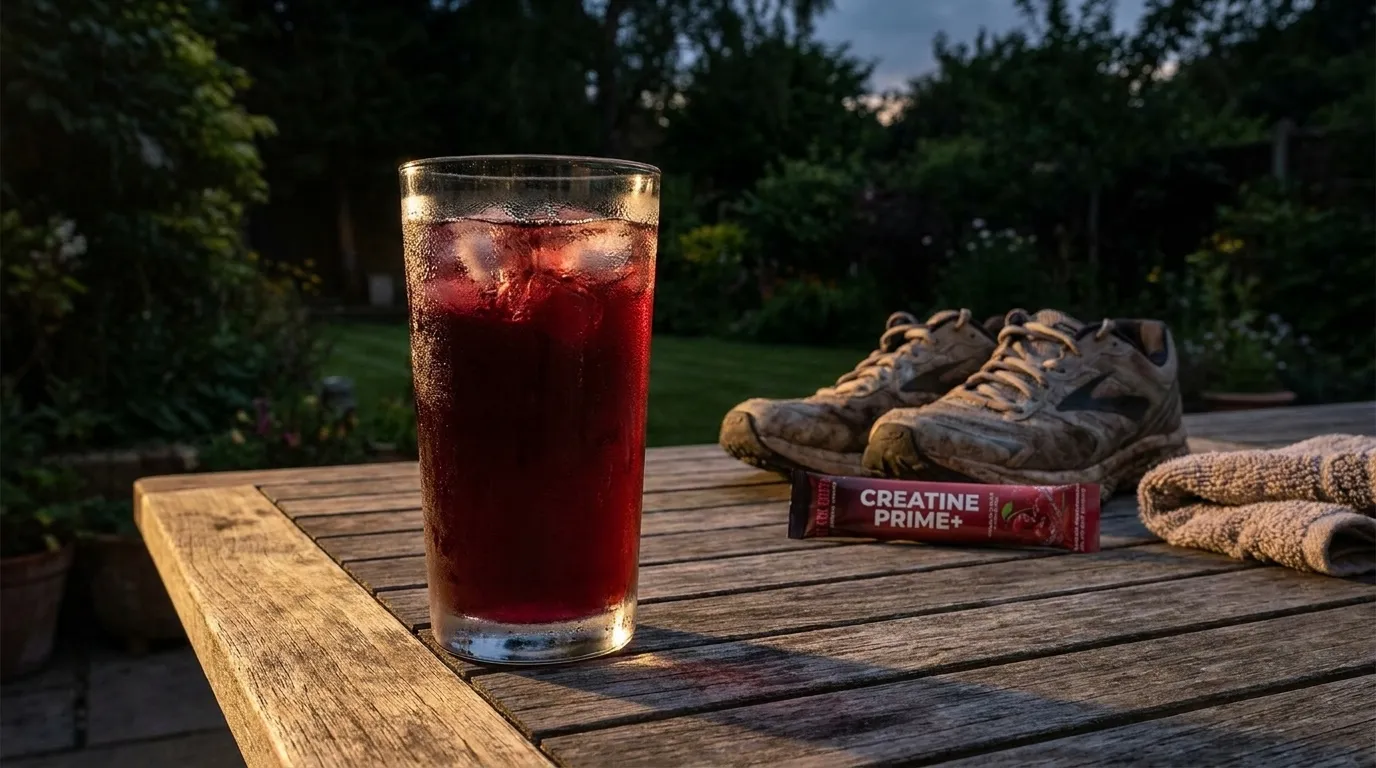
The first three days, I felt nothing. I'll be honest about that, because I think it's the most useful thing I can tell you. I'd stirred a stick pack of Black Cherry into a glass of cold water every morning, waited for some dramatic switch to flip, and got — a nice drink. That's it. Then somewhere around day ten, I noticed I'd stopped dreading the stairs at the back of my building. Small thing. But real.
That's the honest shape of what creatine and rhodiola do. They're not a jolt. They're a slow filling-in of a buffer you didn't know had run low. So instead of promising you a lightning bolt, I want to walk you through the actual timeline — what tends to show up first, what takes longer, and what's happening underneath. I'm a dietitian, and I read the studies on Creatine Prime+ before I'd let my name near it.
Why two ingredients, and why these two
Creatine Prime+ is deliberately short: Creatine Monohydrate and Rhodiola (RhodioPrime 6x). No stimulant stack, no eleven-ingredient "matrix." The logic is that these two cover different halves of the same problem — having enough energy to get through a demanding day and recover from it.
Creatine is the body's rapid ATP recharge system. ATP is the cell's fast-spend energy currency, and creatine keeps it topped up by refilling the phosphocreatine pool your muscles and brain draw on during effort. The nice part: no caffeine, no jitters, no crash. It's also the most extensively studied form of creatine and is well tolerated long-term, which is why the International Society of Sports Nutrition's position stand on creatine safety and efficacy treats monohydrate as the reference standard.
Rhodiola works on a different axis. It's an adaptogen — its actives, rosavins and salidroside, modulate your stress-response and central neurotransmission. Translated: it helps blunt the mental fatigue that piles up over a long, demanding day. Put them together and you get a physical energy buffer plus a stress buffer. That's the whole idea.
Week one: recovery is usually first
For most people, the earliest thing they notice isn't focus or energy — it's that workouts stop lingering as long. One of our reviewers put it plainly: "I've noticed my recovery feels smoother after workouts." Another said, "It's been a small but real help for me." I like that second one because it's not hype. It's accurate.
Here's the mechanism. Creatine increases the muscle's phosphocreatine pool, which lets muscle cells regenerate ATP faster during effort. When you pair that with everyday activity or resistance training, research — including a meta-analysis on creatine, resistance training, and muscle strength in older females — points to greater gains in strength and lean tissue, which helps offset the muscle loss that accelerates with age. You don't feel "strength gains" on day five. You feel that the day after leg day is less brutal than it used to be.
A note on timing: your muscle stores fill gradually with a daily dose. You can front-load, but I don't bother. Steady and boring wins.

Weeks two to four: the steadier energy shows up
This is the one that surprised me. Not a spike of energy — a flatter, less-dippy day. The 3 p.m. wall got shorter. Two reviewers captured it better than I can: "Feels like my body handles busy days a little better," and "I just feel steadier and more focused lately."
Why steadier rather than higher? Because creatine isn't adding fuel, it's keeping your existing ATP recharge topped up so you're less likely to hit empty under repeated demand. Rhodiola contributes here too. In demanding, fatiguing conditions — the classic study followed physicians on night duty — a standardized rhodiola extract improved mental performance and reduced the feeling of mental fatigue. That's exactly the "handles busy days better" sensation, described in a lab.
If you're expecting a pre-workout kick, you'll be disappointed, and that's by design. The absence of jitters is a feature.
The focus piece — and who it matters most for
Clearer thinking tends to be the slowest and most personal of the benefits. Some people feel it in week two; some notice it mostly on their worst, most-frazzled days. "My mind feels a bit clearer throughout the day," is how one reviewer described it.
The brain is metabolically greedy, so raising brain creatine stores gives neurons a larger energy buffer for tasks like memory and attention. Systematic reviews on creatine and cognition — including work in older adults and a meta-analysis on memory in healthy individuals — suggest this matters more as natural creatine levels and brain energy decline with age.
There's a specific group I want to flag, because the research is genuinely interesting here: women moving through perimenopause and menopause. Hormonal shifts in that window are linked to lower brain energy and the "brain fog" so many describe. A randomized controlled trial in perimenopausal and menopausal women found creatine supplementation raised frontal-lobe creatine and supported cognition and steadier mood during that transition. Rhodiola rounds it out — trials in people with stress-related burnout and chronic fatigue report clear improvement in perceived stress and exhaustion. If that's the season you're in, this is the part of the label to pay attention to.
The part that has nothing to do with science
I'll be candid: the best supplement is the one you actually take, and most people quit because the routine is annoying. So the format matters more than we like to admit.
- Single-serve stick packs. "No mess, no measuring, which I appreciate," as one reviewer said — and honestly, same. I keep a couple in my bag.
- It mixes instantly. No chalky sludge at the bottom of the glass. "This mixes instantly and tastes better than I expected."
- The Black Cherry flavor. "Easy to drink and not overly sweet," which for a daily habit is the whole ballgame.
How I actually take it
- One stick pack into 8–12 oz cold water — more water if you like it lighter.
- Stir or shake about 10 seconds. It dissolves before you're done.
- Same time every day. I do it with breakfast so I never forget. Consistency beats timing.
What to honestly expect
Give it about three to four weeks before you judge it. The changes are cumulative, not instant, because you're building up stores rather than borrowing energy. And they're subtle — a smoother recovery, a flatter energy curve, a clearer head on hard days. If you're chasing a buzz, this isn't that. If you want a quiet, well-studied buffer under your busy weeks, that's exactly what it's built to be.
The most common feedback we get isn't dramatic. It's "a small but real help." I think that's the honest ceiling for good ingredients — and a fair one.
These statements have not been evaluated by the Food and Drug Administration. This product is not intended to diagnose, treat, cure, or prevent any disease. The studies referenced above describe the individual ingredients — creatine monohydrate and rhodiola — and not this finished product. Individual results vary. If you are pregnant, nursing, taking medication, or have a medical condition, talk with your healthcare provider before starting any supplement.
Priya is a registered dietitian who reviews the science behind every ingredient we use. She spends her days turning clinical research into plain English.
Ready to try it for yourself?
Shop Superfoods Company