The Slow-Burn Focus: What Ashwavana Guru Focus Actually Does to Your Body

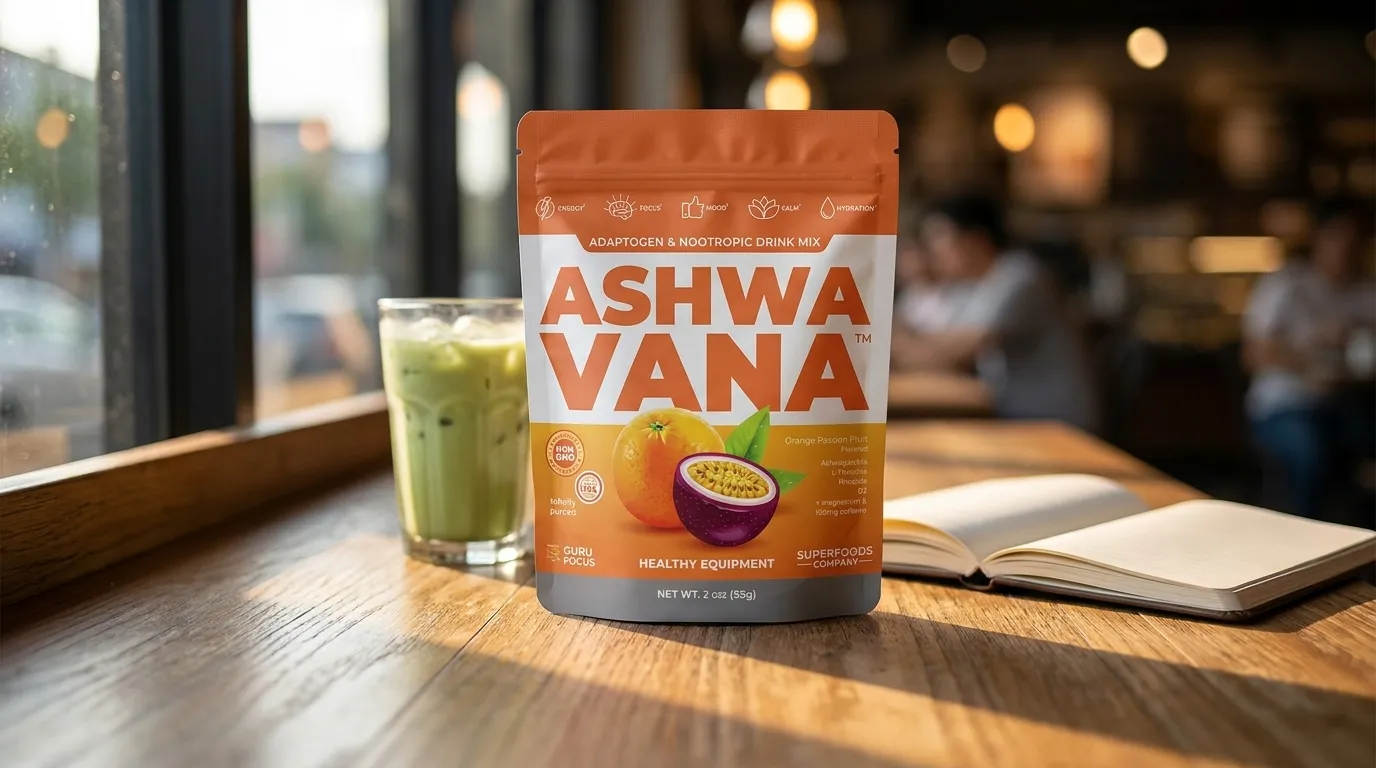
The first time I noticed it, I was three tabs deep into a research paper at a café near my office and realized I'd forgotten to be anxious. That's a strange sentence to type as a dietitian, but it's accurate. Normally by 2 p.m. I'm running on a second coffee and a low hum of jitter. This was different — awake, but quiet. A friend who takes it put it better than I could: it leaves her "awake but BALANCED with a happy energy."
I spend most of my working life reading the studies behind ingredients and translating them into something a normal human can act on. So instead of telling you Ashwavana Guru Focus "boosts focus," I want to show you the actual machinery — what each part is doing, and where the honest limits are. There are fifteen ingredients. I'll group them by the job they do.
Job one: turn the volume down (so focus has room)
Focus isn't just stimulation. A lot of the time, what wrecks concentration is background stress — the mental tab you can't close. Two ingredients target that directly.
Ashwagandha is the headliner. It's an adaptogen that works on the hypothalamic-pituitary-adrenal (HPA) axis — the loop that governs your cortisol response. In practice it blunts how hard your body slams the cortisol pedal under chronic stress. Trials like An investigation into the stress-relieving and pharmacological actions of an ashwagandha extract and the Prospective, Multi-Centric, Randomized, Double-Blind, Placebo-Controlled Study to Evaluate the Efficacy and Safety of KSM-66 Ashwagandha in Adults Experiencing High Stress and/or Anxiety found lower perceived stress and lower morning cortisol. Lower morning cortisol tends to read as calmer, steadier energy rather than a wired feeling. That matters — as one review of the two herbs put it, research suggests they work through different pathways, and ashwagandha's is the "help the body adapt to stress" lane rather than the stimulant lane.
Lemon balm (Melissa officinalis) plays a supporting role. Its rosmarinic acid nudges GABA pathways — the brain's main "calm down" signaling — which is why it's been studied for attenuating lab-induced stress and supporting a balanced mood. Nothing dramatic. More like the difference between a room with the fluorescent buzz on versus off.
"It makes me feel so focused, calm, and productive all day." — a phrase from our reviews that, honestly, describes the whole design goal.
Job two: sharpen attention without the jitter
This is the part I find most interesting, because it's a genuine pairing effect, not one hero ingredient.
L-theanine is an amino acid from tea. It raises alpha brain-wave activity — the pattern associated with relaxed, alert states — and acts as a mild neural relaxant. On its own it's calming. Paired with caffeine, it does something better: it smooths the stimulant's rough edge. In the study High-dose L-theanine-caffeine combination improves neurobehavioural and neurophysiological measures of selective attention in acutely sleep-deprived young adults, the combination improved sustained and selective attention. A separate randomized trial, Effects of L-Theanine Administration on Stress-Related Symptoms and Cognitive Functions in Healthy Adults, backs the stress-and-cognition angle.
Matcha green tea is where that pairing shows up naturally in the cup. Matcha comes with L-theanine, a moderate dose of caffeine, and EGCG catechins together — the same combination researchers have tied to calm, focused attention and mood in work like An intervention study on the effect of matcha tea on mood and cognitive performance. Independent write-ups on matcha are careful here, and so am I: the smoother feel is a mechanism-supported description, not a guaranteed no-crash promise for every person. Caffeine metabolism is personal. But the design logic is sound — moderate caffeine, buffered by theanine, absorbed alongside catechins that slow the spike.
That's the source of the phrase you see over and over in our reviews — "I love the energy and focus without the jitters," and the one I quietly agree with: "without any sort of crash."
Rhodiola rosea rounds out this group. It's the adaptogen for the specific problem of mental fatigue under pressure. The classic study — Rhodiola rosea in stress-induced fatigue, a double-blind cross-over of standardized extract SHR-5 on the mental performance of physicians during night duty — tested it on exactly the population you'd want to test it on: tired people who still need to think clearly. It influences stress-response and monoamine signaling rather than acting as a stimulant, so it supports concentration when you're running low without adding to the buzz.

Job three: feed the brain with better blood flow
Here's something people skip: your brain is a flow-dependent organ. Attention and stamina ride on circulation. Three ingredients work on that plumbing.
- Beet root is rich in dietary nitrate, which your body converts to nitric oxide — that widens blood vessels and can increase regional brain perfusion. The study Dietary nitrate modulates cerebral blood flow parameters and cognitive performance in humans found nitrate changed the frontal-cortex blood-flow response during a task. Worth an honest caveat: not every trial agrees — a 13-week study in older overweight adults found no cognitive or blood-flow change, so effects vary by dose, person, and timeframe.
- Grape seed extract delivers proanthocyanidins — potent antioxidants shown to improve endothelial (blood-vessel lining) function and promote vasodilation in trials like the grape seed proanthocyanidin study in prehypertension, with a 16-trial meta-analysis supporting a blood-pressure effect.
- Pomegranate brings ellagitannins (punicalagin, ellagic acid) — antioxidant, anti-inflammatory, and in memory studies like Pomegranate Juice Augments Memory and fMRI Activity in Middle-Aged and Older Adults, associated with task-related brain activity.
Job four: keep energy steady (no spike, no dip)
The 3 p.m. crash is often a blood-sugar story, not a willpower story. Two kitchen-spice ingredients earn their place here.
Cinnamon polyphenols improve insulin sensitivity and slow gastric emptying — the meta-analysis Cinnamon Intake Lowers Fasting Blood Glucose is the reference point. Ginger root gingerols support digestion and, per The Effect of Ginger Aqueous Extract on Postprandial Glycemia in Nondiabetic Adults, can blunt the post-meal glucose spike. Flatter glucose curve, fewer energy cliffs, fewer of the cravings those cliffs trigger. That's the mechanism behind reviewers saying it curbs their appetite.
Job five: the mood-and-maintenance crew
Not every ingredient is about the next 90 minutes. Some are playing a longer game.
- Vitamin D3 acts on receptors throughout the brain and endocrine system. If your level is low, correcting it is linked to better mood and less fatigue — the meta-analysis The effect of vitamin D supplementation on depression covers this. If you're already replete, expect less; the benefit is largest when you're topping up a deficiency.
- Vitamin K2 is D3's partner. It activates matrix Gla protein and osteocalcin, routing calcium into bone and away from arteries — the synergy is laid out in The Synergistic Interplay between Vitamins D and K for Bone and Cardiovascular Health. D3 raises calcium availability; K2 helps put it in the right place.
- Turmeric (as curcumin) lowers pro-inflammatory markers like IL-6 and modulates neurotransmitter pathways — the trial Curcuma longa extract improves serum inflammatory markers and mental health ties that to mood support.
- Chlorella and goji berry round out the greens-and-antioxidant side of the profile.
Add it up and you get a blend that isn't trying to whip your nervous system into a sprint. It's lowering the noise, sharpening attention, feeding blood flow, and flattening the energy curve — all at once. Which is why a reviewer described it as "calm, steady energy, better focus, and great hydration," and another said, simply, that it "keeps my anxiety at bay."
My honest take
Adaptogens and polyphenols are cumulative, not switch-flip. A few people feel the calm-focus effect the first day; most of what I'd trust — the cortisol and mood pieces especially — shows up over two to four weeks of consistent use. It's a very good, cleaner replacement for a second coffee. It is not a substitute for sleep, protein, or actually closing your laptop at night. Take it in daylight, expect a nudge rather than a jolt, and give it a couple of weeks before you judge.
These statements have not been evaluated by the Food and Drug Administration. This product is not intended to diagnose, treat, cure, or prevent any disease. The research described above investigates individual ingredients, not this finished product, and individual results vary. If you are pregnant, nursing, taking medication, or managing a health condition, talk with your healthcare provider before starting any supplement.
Priya is a registered dietitian who reviews the science behind every ingredient we use. She spends her days turning clinical research into plain English.
Ready to try it for yourself?
Shop Superfoods Company