The Quiet Case for Creatine Prime+: What Two Ingredients Actually Do for You

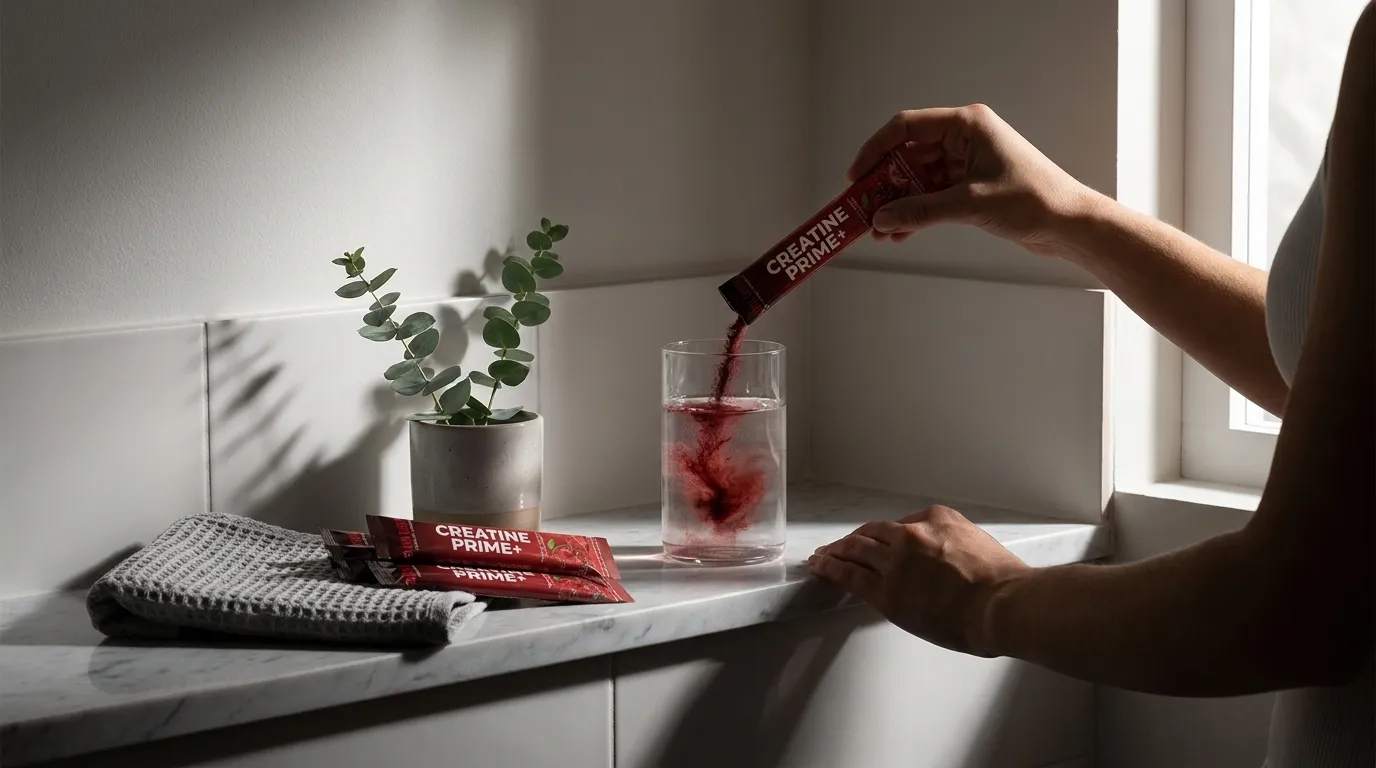
I keep a stick pack tucked in the little zip pocket of my gym bag, and most mornings I make it the day before I actually need it — I tear one open in the bathroom while my coffee is still brewing, tip it into a glass of water, and drink it before I've decided what kind of day it's going to be. That's the honest ritual. Not heroic. Just consistent. And after a few years of reading the research on these two ingredients, that "small but consistent" part is exactly where the benefits live.
People ask me what Creatine Prime+ is supposed to do, and I get why the question feels slippery. It's two ingredients — creatine monohydrate and a standardized rhodiola extract (RhodioPrime 6x). No stimulant. No long, mysterious label. So let me walk through what each one is actually doing in your body, where the science is genuinely strong, and where I'd tell you to keep your expectations reasonable.
Start with the cell: creatine is an energy buffer
Here's the mechanism in plain English. Your cells run on ATP — the little rechargeable battery that powers basically everything, from a muscle contraction to a neuron firing. When you push hard, you burn through ATP faster than you can make it. Creatine's job is to sit in your cells as phosphocreatine and recharge that battery quickly, so you have a bigger buffer to draw from before you run low.
That's it. That's the whole trick. It's not a stimulant, so there's no lift-then-crash — it's more like topping up a reserve tank you already have.
Muscle is the classic place this shows up. Creatine increases the muscle's phosphocreatine pool, which lets muscle cells regenerate ATP faster during effort. Paired with everyday activity or resistance training, that tends to translate into better strength and lean tissue over time. I want to be precise here, because it matters: creatine doesn't build muscle for you. It gives you a little more to work with when you do the work. The training still has to happen.
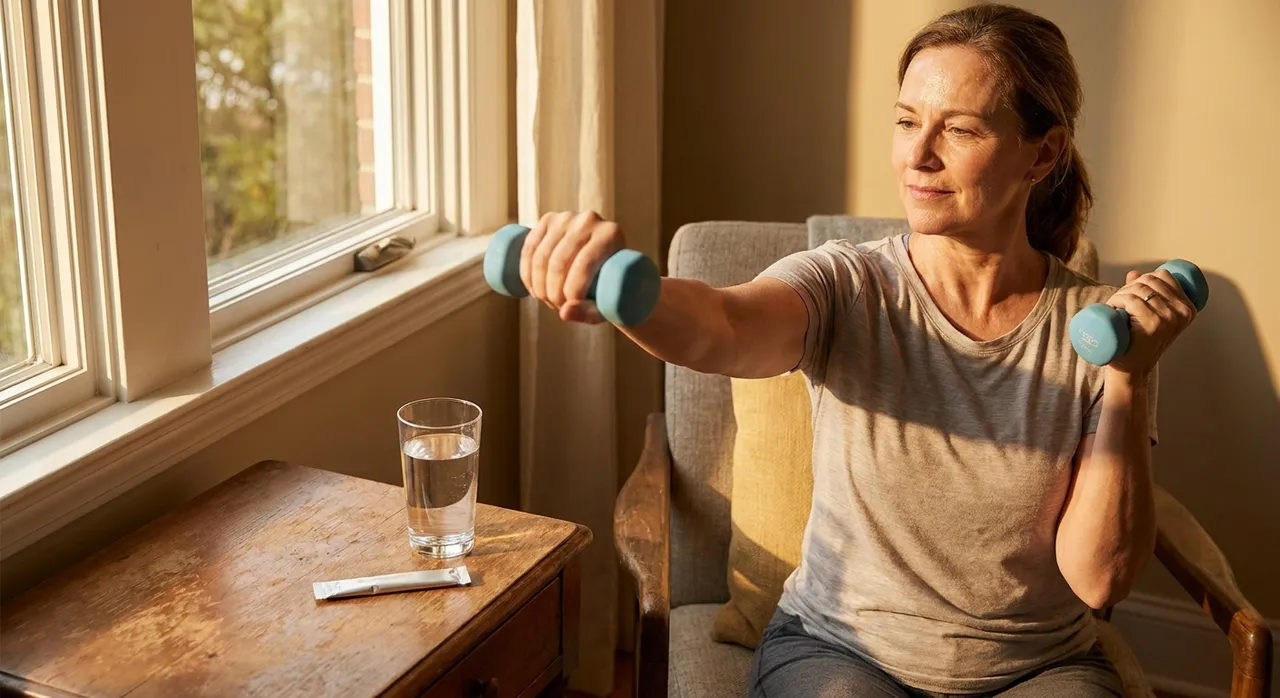
This is also why I get genuinely enthusiastic recommending it to women in their 40s, 50s, and beyond. The systematic reviews and meta-analyses on creatine combined with resistance training in older females point to greater gains in strength and lean mass than training alone — which is a big deal when age-related muscle loss starts to accelerate. If you're going to do the strength work anyway (please do), this is a low-risk way to get more out of it.
The part people underrate: your brain runs on ATP too
The brain is metabolically greedy — it's one of the most energy-demanding tissues you have. So the same logic applies: raising brain creatine stores gives neurons a larger energy buffer for demanding tasks like memory and attention. A recent systematic review and meta-analysis on creatine and cognitive function found that creatine supplementation significantly improves memory and information processing speed and shows positive effects in specific executive function tests. The proposed reasons line up neatly with the mechanism above — creatine may enhance cognitive function through various mechanisms, such as increasing brain energy supply, regulating neurotransmitter levels, and improving neuronal function.
Two honest caveats from me, because I'd rather you trust me later. First, the included studies exhibited heterogeneity in design, sample size, and testing methods, so the effect isn't uniform across every person or every task. Second, the cognitive benefits tend to be most noticeable when your brain is under stress — sleep-deprived, mentally taxed, or when natural creatine and brain energy have declined with age. If you're well-rested and unstressed, the difference may be subtle. That's not a knock; it's just how the biology works.
This is also where a lot of the research on women's health has gotten interesting. The hormonal shifts of peri- and post-menopause are linked to lower brain energy and that maddening "brain fog." Trials in menopausal and perimenopausal women (including the CONCRET-MENOPAUSE randomized controlled trial) have looked at whether supplemental creatine can raise frontal-lobe creatine and support faster reaction time and steadier mood through that transition. Promising, still an active area of study — I'll tell you when it's ironclad, and we're not fully there yet — but the direction is encouraging.
Why we added rhodiola (and why it's not just filler)
Creatine is a battery. Rhodiola is more of a thermostat for stress. It's an adaptogen — a plant that helps your body adapt to physical and psychological load — and its active compounds, rosavins and salidroside, work on your stress-response system and central neurotransmission.
What does that feel like? In demanding, fatiguing conditions, standardized rhodiola extracts have been shown to improve mental performance — concentration, short-term memory, speed of perception — while reducing the sense of mental fatigue. One of my favorite studies for illustrating this looked at physicians on night duty (a brutally real-world stress test), using a repeated low-dose regimen of a standardized extract. And in people dealing with prolonged or stress-related burnout and chronic fatigue, open-label and controlled trials report meaningful improvements in perceived stress and exhaustion.
So the pairing isn't random. Creatine keeps the tank topped up; rhodiola helps you spend that energy more calmly under pressure. Together they aim at the same felt experience — steadier energy and clearer focus on the days that actually ask a lot of you.
What that combination actually feels like
I don't want to oversell the sensations, because the most common feedback we get is refreshingly undramatic. A lot of it sounds like this:
"I just feel steadier and more focused lately." — and, from someone else, "It's been a small but real help for me."
That "small but real" framing is, honestly, the correct expectation. Recovery that feels a bit smoother. A mind that feels a bit clearer through the afternoon. A body that seems to handle a packed day slightly better. These aren't fireworks. They're the kind of quiet upgrades you notice most when you stop taking it for a couple of weeks.
The unglamorous benefits that make it stick
I'll be blunt: the best supplement is the one you'll actually take, and formulation details decide that more than people admit. A few practical wins customers mention constantly:
- It mixes instantly. No clumping, no chalky grit at the bottom of the glass. "This mixes instantly and tastes better than I expected" is a phrase I've read more times than I can count.
- The Black Cherry flavor is easy. As one reviewer put it, it's "easy to drink and not overly sweet." That matters when it's a daily habit.
- Single-serve stick packs. "No mess, no measuring, which I appreciate." You can throw one in a bag, a glovebox, a desk drawer. The convenience is a big part of why the consistency happens — and consistency is the whole game with creatine.
On dosing: creatine works because you keep taking it. Phosphocreatine stores build up over roughly two to four weeks of daily use, then stay topped up as long as you're consistent. You don't need to "load," and you don't need to time it perfectly. Morning, post-workout, with dinner — whatever slot you'll actually remember. Take it with water or a drink you like, and just don't skip it for days on end.
Who I'd point toward it — and who might wait
If you strength train, if you're a woman navigating perimenopause or menopause, if your days are mentally demanding, or if you just want a non-stimulant way to support steady energy and recovery, this is a sensible pick. Creatine monohydrate is the most extensively studied form and is well tolerated long-term. If you're pregnant, nursing, or managing a kidney condition, talk to your own clinician first — that's not a red flag about the ingredient, it's just what a responsible dietitian says.
These statements have not been evaluated by the Food and Drug Administration. This product is not intended to diagnose, treat, cure, or prevent any disease. The research cited above describes the individual ingredients (creatine monohydrate and rhodiola) and does not describe the finished product. Individual results vary, and a supplement works best alongside a balanced diet, adequate sleep, and regular activity.
Priya is a registered dietitian who reviews the science behind every ingredient we use. She spends her days turning clinical research into plain English.
Ready to try it for yourself?
Shop Superfoods Company