Two Ingredients, One Job: How Creatine Prime+ Keeps Your Energy Steady

The first time I really noticed it wasn't in the gym. It was around 3 p.m. on a Tuesday, mid-email, when I realized I hadn't reached for my second (third?) coffee and didn't feel like I needed to. Nothing dramatic — no lightning bolt of energy. Just a quiet, level kind of steady. As the dietitian who reads the studies behind everything we put in a stick pack, I'm skeptical by trade. But that unremarkable Tuesday is exactly the feeling most of our customers describe, and it's worth explaining why it happens.
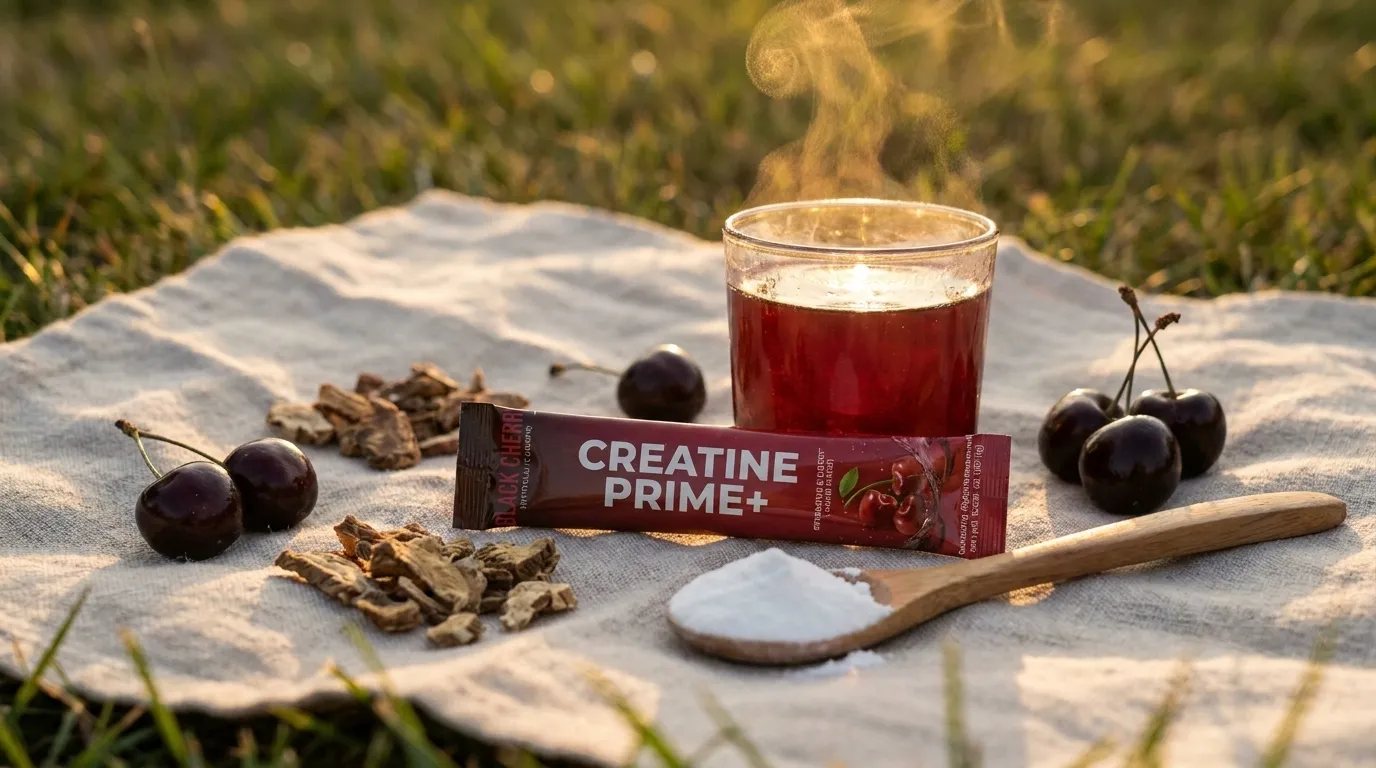
So let's get into the mechanics. Creatine Prime+ has two active ingredients — creatine monohydrate and RhodioPrime 6x rhodiola — and they're not there by accident. One tops up your energy hardware. The other helps you keep your composure when the day gets loud. Here's how each actually works.
Ingredient one: creatine, your cells' fast-charge battery
Most people file creatine under "gym stuff." Fair enough — that's where the research started. But the mechanism is broader than muscle.
Your cells run on a molecule called ATP. It's the currency they spend to do work — contracting a muscle, firing a neuron, holding a thought. The catch is that cells only keep a few seconds of ATP on hand. Creatine's job is to recharge it, fast, by donating a phosphate to rebuild spent ATP. More creatine in the tissue means a bigger buffer to draw from when demand spikes.
That's the muscle story, and it's well established. Muscle power and strength decrease with age leading to reduced independence and increased health risk from falls, and creatine supplementation can increase muscle power and strength. The evidence in older women is especially encouraging — reviews like the Efficacy of Creatine Supplementation Combined with Resistance Training on Muscle Strength and Muscle Mass in Older Females meta-analysis show that pairing creatine with everyday activity or light resistance training helps offset the strength loss that tends to accelerate around and after menopause. And it holds up over time: the significant benefits of creatine plus resistance training can be sustained for up to 32 weeks.
Here's the part I find more interesting, because it explains that 3 p.m. feeling. Your brain is metabolically greedy — it burns a huge share of your daily energy relative to its size. In the brain, creatine may improve cognitive performance by increasing cellular energy reserves and reducing oxidative stress, which is particularly important in tasks requiring high cognitive processing. Reviews such as Creatine and Cognition in Aging and a meta-analysis on creatine and memory in healthy individuals point the same direction: raising brain creatine gives neurons a larger energy cushion for memory and attention — a benefit that matters more as natural creatine levels and brain energy quietly decline with age.
There's also a specific window where this seems to land hard. Hormonal shifts in peri- and post-menopause are linked to lower brain energy and the "brain fog" a lot of women describe. Trials like CONCRET-MENOPAUSE and the review Creatine in Women's Health suggest supplemental creatine raises frontal-lobe creatine and supports faster reaction time and steadier mood through that transition. Not a cure. A support.
"My mind feels a bit clearer throughout the day." — that's one of the most common notes we get, and the ATP-buffer story is the most likely reason why.
One more thing I appreciate as a dietitian: creatine monohydrate is the most extensively studied form, and per the International Society of Sports Nutrition position stand, it's well tolerated long-term. No caffeine, no jitters, no 4 p.m. crash. It's energy support at the cellular level, not a stimulant.

Ingredient two: rhodiola, for the days that push back
Creatine handles the hardware. Rhodiola handles the weather.
Rhodiola rosea is an adaptogen — a plant that helps your body adapt to physical and psychological stress. Its active compounds, rosavins and salidroside, nudge the stress-response system and central neurotransmission. In plain terms: under fatiguing, demanding conditions, it can help you hold your focus instead of watching it fray.
The research I lean on here is refreshingly specific. The classic SHR-5 trial studied physicians working night shifts — about as real-world-stressful as it gets — and found improvements in mental performance: concentration, short-term memory, and speed of perception, alongside a drop in the feeling of mental fatigue. A broader systematic review on rhodiola for physical and mental fatigue echoes it. And in people dealing with prolonged stress and burnout, open-label work reports clear improvement in perceived stress and exhaustion. Broadly, rhodiola may be effective for improving symptoms of stress, fatigue, or depression in the doses used in those studies.
This is the "handles busy days better" ingredient. It doesn't add energy so much as it protects the energy and focus you already have from getting eroded by a stressful stretch.
Why we combined them (instead of picking one)
Think of it as two different problems. Creatine addresses capacity — how much energy your muscles and brain can rapidly access. Rhodiola addresses resilience — how well you hold up when stress tries to drain that capacity. A lot of "energy" products only solve one, or just paper over both with caffeine. We wanted the pair that works on the actual mechanism, quietly.
That's why the feedback tends to sound so understated. People don't say they feel wired. They say:
- "I've noticed my recovery feels smoother after workouts."
- "Feels like my body handles busy days a little better."
- "I just feel steadier and more focused lately."
"Steadier" is the word that comes up again and again. It's not a marketing line — it's the honest shape of what two well-chosen ingredients do.
How to actually get the benefit
Mechanisms only matter if you take it consistently, so here's the practical part.
- Dose: Creatine research settles on a simple maintenance number — the standard dosage recommendation is 3–5 grams, and 5 grams is the most-studied dosage linked with the benefits most people seek. Each stick pack is measured for you.
- Consistency beats timing. Creatine works by saturating your tissues over time, so the daily habit matters far more than the exact hour. Morning, post-workout, with lunch — pick whatever you'll actually remember.
- Give it a few weeks. This is the honest caveat: you're building up stores, not flipping a switch. Most people feel the "steadier" effect settle in after a couple of weeks, not day one.
- Just add water. One pack, a glass of cold water, stir. It mixes instantly — no blender, no clumps.
And yes, the taste genuinely matters for consistency. One customer put it better than I could: "This mixes instantly and tastes better than I expected." Another said the "Black Cherry flavor is easy to drink and not overly sweet." When something tastes good and there's "no mess, no measuring," you actually keep doing it — which is the whole point.
My take, for whatever a skeptical dietitian's opinion is worth: this isn't a miracle, and I'd be suspicious of anyone who sold it as one. It's a small, real, science-backed nudge. As one review we got says, "It's been a small but real help for me." That's a claim I can stand behind.
These statements have not been evaluated by the Food and Drug Administration. This product is not intended to diagnose, treat, cure, or prevent any disease. The studies referenced above describe the individual ingredients — creatine monohydrate and rhodiola — and not the finished product. Individual results vary. If you are pregnant, nursing, taking medication, or have a medical condition, talk with your healthcare provider before starting any supplement.
Priya is a registered dietitian who reviews the science behind every ingredient we use. She spends her days turning clinical research into plain English.
Ready to try it for yourself?
Shop Superfoods Company