What a Collagen Coffee Does for Your Skin (And What It Can't)

I keep a little magnifying mirror on my bathroom shelf, which is a terrible habit for anyone over 35. One February morning, coffee in hand, I was prodding at the fine lines under my eyes and a question I get asked constantly landed differently: does the collagen in my coffee actually reach my skin, or am I just drinking a very expensive placebo?
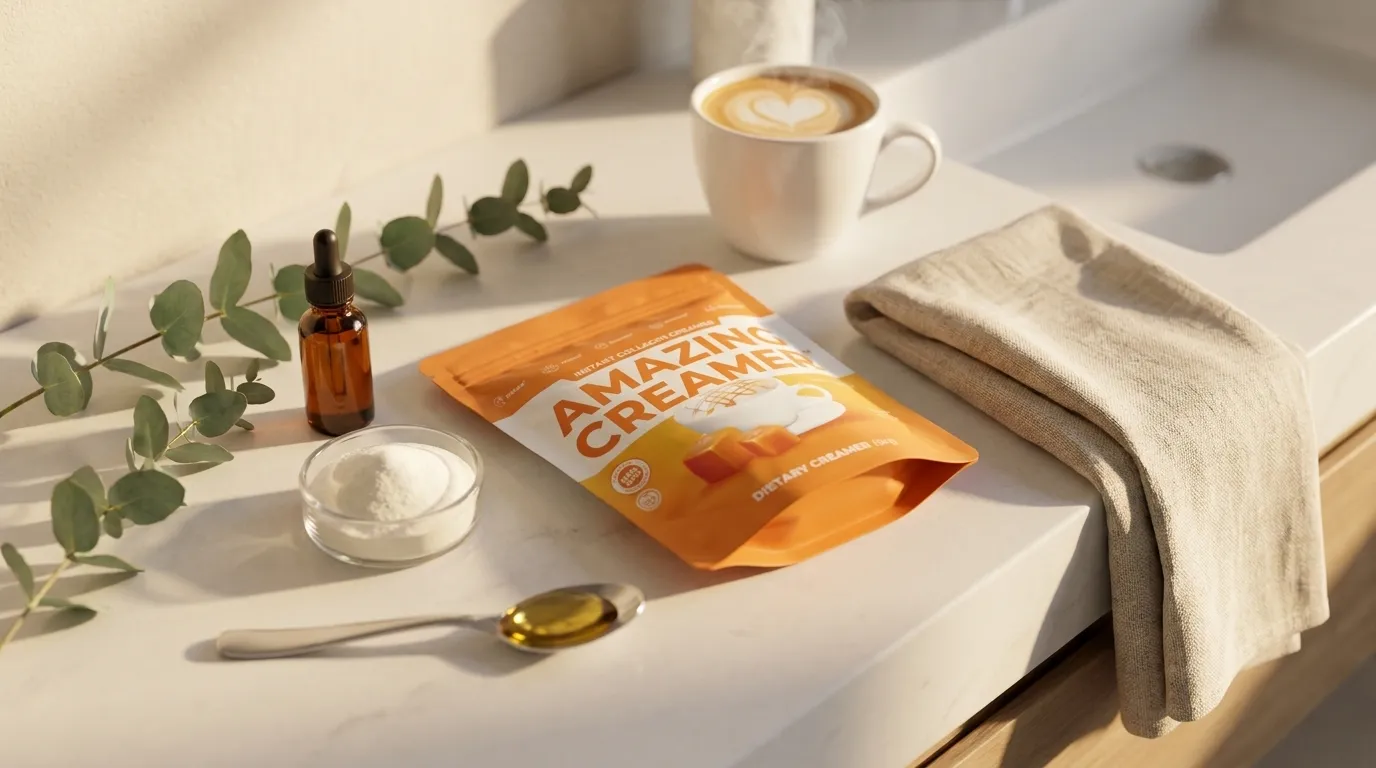
Fair question. I'm a dietitian — I read the studies before I believe the marketing, and I've read a lot of bad collagen marketing. So let me walk you through what the research actually supports about collagen coffee for skin health, where the hype runs ahead of the evidence, and how the three active ingredients in Amazing Creamer — collagen, hyaluronic acid, and MCT oil — each play a role.
First, the question everyone asks: does hot coffee "kill" the collagen?
This is the objection I hear most, and it comes from a real place. Raw collagen — the kind in bone broth or your own skin — is a tightly wound triple helix, and heat does unravel it. But that's not what's in a quality creamer.
The collagen in supplements is hydrolyzed, meaning it's already been broken down into short peptides. When people argue that heat "melts" the collagen, they're often referring to the native, raw form found in skin or bone; since a hydrolyzed peptide powder has already had that structure modified to be more functional, the concern doesn't apply the same way. The structure you're worried about damaging is gone before the powder ever hits your mug.
The consensus across the sources I checked is reassuring. Hydrolyzed collagen peptides are deliberately thermally denatured and enzymatically cleaved into small peptides during production, so they remain stable at typical cooking and drinking temperatures and remain digestible. One guide put it plainly: hot coffee does not destroy collagen peptides — the temperatures reached in coffee or tea are well below those that cause significant peptide degradation.
So no, your morning cup isn't sabotaging anything. If anything, pairing the dose with a habit you already have is the smartest part. Hydrolyzed peptides are heat-stable through any normal hot drink temperature, and pairing the daily dose with morning coffee is one of the most effective ways to keep a routine going. Consistency is where skin results live or die.

What the skin trials actually show
Here's where it gets genuinely interesting. Ingested collagen peptides don't just get digested into nothing — some are absorbed as small peptides and amino acids, and the research suggests they nudge the skin's own machinery.
The mechanism, in plain English: collagen supplementation supplies the amino acids that serve as building blocks for dermal collagen synthesis, and the peptides may stimulate fibroblast activity, which is the skin's collagen-making workforce. That's the theory. The trials are what matter.
- Hydration, elasticity, wrinkles. A randomized, double-blind, placebo-controlled study on low-molecular-weight collagen peptides set out to clinically evaluate the effect on human skin hydration, wrinkling, and elasticity. Those are the three outcomes that keep showing up across the literature.
- Dose and time matter. One clinical trial saw a significant improvement in skin elasticity of more than 17.1% after 8 weeks of supplementation. Note the word weeks. Skin turns over slowly.
- How hydration improves. A meta-analysis pointed to the mechanism beneath the glow: oral supplementation of collagen peptides improves skin hydration by increasing the natural moisturizing factor content in the stratum corneum. In other words, it changes what's happening in the skin itself, not just the surface.
The hyaluronic acid angle
Collagen gets the headlines, but hyaluronic acid is the quiet multiplier in a collagen coffee — and it's the ingredient that makes Amazing Creamer's formula more than a one-note collagen scoop.
Hyaluronic acid is a humectant. The number you'll see everywhere is real: hyaluronic acid can hold up to 1,000 times its weight in water, which helps replenish hydration that naturally drops as we age. A dermatologist's description of how it works is useful here — it binds with water to pull it into the outer skin layer, and because skin loses moisture as we age, this ingredient helps store hydration.
And oral HA isn't just topical-talk. In a clinical study, participants drank a hyaluronan solution once daily in the morning and were advised to follow it with a glass of still water to let the HA hydrate as soon as possible — which, incidentally, is good practice with any collagen coffee: have some water alongside it. The outcome researchers measured was telling. That oral hyaluronan study reported improvements in skin hydration, wrinkle reduction, elasticity, and skin roughness. Same four words again: hydration, elasticity, wrinkles, roughness.
Where MCT oil fits (it's not just for energy)
MCT oil is in the creamer mostly for steady energy and satiety, and that's where most people notice it. But there's a skin-adjacent reason it belongs in a morning cup too: fat helps you actually absorb the fat-soluble players in your diet, and the oil gives the drink body so you don't reach for a sugary creamer that works against your skin. The research I rely on for MCT credits its rapid absorption and metabolism to ketones — useful context, but I'll be honest, MCT is a supporting actor in the skin story, not the lead.
The combination is the point
Here's the part I find most compelling as a dietitian. Researchers have tested these ingredients together, not just in isolation. A randomised, double-blind, placebo-controlled trial examined the effects of dietary supplementation with collagen and vitamin C and their combination with hyaluronic acid on skin density, texture and other parameters. That's the direction the science is moving — stacked ingredients, not single scoops. Amazing Creamer lands in that same combination logic: collagen for the building blocks, hyaluronic acid for water retention, MCT for the energy and mouthfeel that keep you drinking it.
An honest timeline (so you don't quit at week two)
This is the caveat I give every single customer: nothing in a mug of coffee works in a week. The trials run 8 to 12 weeks for a reason. If you're going to judge your results, judge them in March if you start in January.
- Weeks 1–3: You'll mostly notice the drink — smoother coffee, steadier energy, less snacking before lunch. Skin changes aren't happening on the surface yet.
- Weeks 4–8: This is the window where hydration measures start moving in the studies. Subjectively, people describe skin that feels less tight and "bounces back" a little better.
- Weeks 8–12+: The elasticity and roughness numbers in the research. This is the real finish line.
Our reviews track this almost exactly — the skin feedback tends to arrive after the energy and appetite feedback. One customer told us flatly, "My only regret is not trying it sooner!" and another said, "I don't ever want to go back to regular coffee." Those aren't skin claims, but they explain why the skin claims eventually show up: people stick with it because the daily experience is genuinely pleasant. A collagen coffee you don't want to drink is a collagen coffee that doesn't work, because you stop.
How I'd actually use it for skin
- Make it daily, same time. Morning coffee is the anchor habit. Don't overthink it.
- Chase it with water. Hyaluronic acid works by pulling in water — give it something to pull.
- Add a vitamin-C source to your morning (fruit, a glass of citrus). The combination trials pair collagen with vitamin C for a reason, as it's a cofactor in collagen synthesis.
- Stir, don't just dump. Give it 10–15 seconds of real stirring so it dissolves smooth — grittiness is almost always under-mixing, not a bad product.
- Commit to 8 weeks before you decide. Please. The studies don't show results faster, and neither will your face.
Will a collagen coffee replace sunscreen, sleep, and not smoking? Absolutely not — and anyone who tells you otherwise is selling, not advising. But as a low-effort, evidence-backed addition to a routine you already have? The trials on collagen peptides and oral hyaluronic acid are some of the more consistent I've read in the "beauty from within" space. For something you were going to drink anyway, that's a pretty good deal.
My take: don't buy a collagen coffee expecting a filter. Buy it expecting slightly better-hydrated, slightly springier skin in two to three months — and treat everything before that as free energy and fewer 10 a.m. cravings.
These statements have not been evaluated by the Food and Drug Administration. This product is not intended to diagnose, treat, cure, or prevent any disease. The studies referenced here investigate individual ingredients — collagen peptides, hyaluronic acid, and MCT oil — and not the finished Amazing Creamer product. Individual results vary. If you are pregnant, nursing, taking medication, or managing a health condition, talk with your healthcare provider before adding any supplement to your routine.
Priya is a registered dietitian who reviews the science behind every ingredient we use. She spends her days turning clinical research into plain English.
Ready to try it for yourself?
Shop Superfoods Company