
The Chemistry of Calm Energy: How to Get Coffee's Lift Without the Jitters


The first time I really noticed the difference, I was standing in my kitchen at 10:07 a.m. holding a spoon that wouldn't stay still. I'd had two big cups of dark roast on an empty stomach before a morning of client calls, and my heart was doing this fluttery little tap-dance while my brain, oddly, felt foggier than before I drank anything. Wired and useless at the same time. If you've felt that, you know exactly the sensation I mean — and it's the reason I spend a good chunk of my week reading caffeine research.
Here's the thing most coffee marketing gets wrong: the goal isn't more stimulation. It's cleaner stimulation. So let me walk you through what actually causes the shakes, and the specific compounds that change the shape of that energy curve.
Why coffee gives you the jitters in the first place
Caffeine doesn't hit the body through a single door. Amazing Coffee still contains real caffeine, so this matters. According to Dr. Angela Zivkovic, a nutrition professor at UC Davis and a faculty member of the university's Coffee Center, caffeine molecules travel through different mechanisms in the body — the compounds that increase alertness are processed through one biochemical pathway, while the compounds that lead to higher anxiety go through another. In other words, "alert" and "anxious" aren't the same signal wearing different hats. They're separate routes.
The jittery route runs largely on adrenaline. Caffeine increases blood pressure because it pushes adrenaline through your body, which makes your heart work harder to pump blood. That's the racing-heart, shaky-hands feeling. And it lingers longer for some of us than others — people with certain gene variants process caffeine more slowly, so it stays in the bloodstream longer and prolongs those stimulating effects, which can add to feelings of anxiety. If you've ever wondered why your friend can slam an espresso at 4 p.m. and sleep fine while you're staring at the ceiling — that's genetics, not willpower.
So the jitters aren't a mystery. They're an adrenaline problem, made worse by how fast the caffeine arrives and how slowly your particular body clears it.
The compound that changes the ride: L-theanine
This is the part I find genuinely interesting. There's an amino acid in green tea and matcha called L-theanine, and it seems to file the sharp edges off caffeine without dulling the alertness. It's not folklore — it's one of the better-replicated findings in this little corner of nutrition science.
In one frequently cited study, researchers compared 50 mg of caffeine with and without 100 mg of L-theanine, and the combination improved both speed and accuracy on an attention-switching task at 60 minutes, and reduced susceptibility to distracting information in a memory task at 60 and 90 minutes. A separate trial found that 97 mg of L-theanine combined with 40 mg of caffeine helped focus attention during a demanding task. Notice the caffeine doses in those studies are modest — roughly half a cup of coffee. The point isn't a bigger jolt. It's a steadier one, with less mind-wandering.
Amazing Coffee leans on this pairing directly, with matcha and green tea sitting right alongside the coffee and added caffeine. That's not decoration on the ingredient list. It's the mechanism.
What "smoother" actually means
I want to be honest here, because I've seen this oversold. Matcha can feel smoother than coffee because it combines a moderate caffeine dose with L-theanine — but that's a mechanism-supported description rather than a guaranteed no-crash effect, and it's not wise to plan around a fixed all-day release window. Some tea sources describe L-theanine helping the body absorb the natural caffeine more slowly, resulting in a sustained three-to-six-hour stretch of energy without the crash or jitters that may come with other caffeinated drinks. Take that as a reasonable description of the direction, not a stopwatch promise. Your genetics, your breakfast, and your sleep all still get a vote.
The slow-drip factor: chlorogenic acid from green coffee
The other lever is how fast caffeine and sugar hit your bloodstream. Green coffee — unroasted coffee beans — is rich in chlorogenic acids, and those compounds do something useful to the glucose side of the equation. Chlorogenic acid can reduce carbohydrate uptake, with the most promising result being 6.9% reduced glucose absorption in the intestines. Reviews of green coffee note that chlorogenic acid appears to slow the absorption of fat from food intake and also activates the metabolism of extra fat.
Why does a dietitian care about that in a jitters article? Because a lot of what people call a "coffee crash" is actually a blood-sugar swing — a spike from a sweetened drink followed by the dip. Smoothing the glucose curve smooths the mood curve with it. This is also why so many of our reviewers mention appetite. As one put it,
"It really does curb your appetite. You need to allow it to work, after you drink your cup just relax and feel the fullness!!"That "give it a minute" instinct is more sensible than it sounds.
The supporting cast: energy without the adrenaline shove
Instead of piling on stimulants, Amazing Coffee builds energy from a few different angles at once:
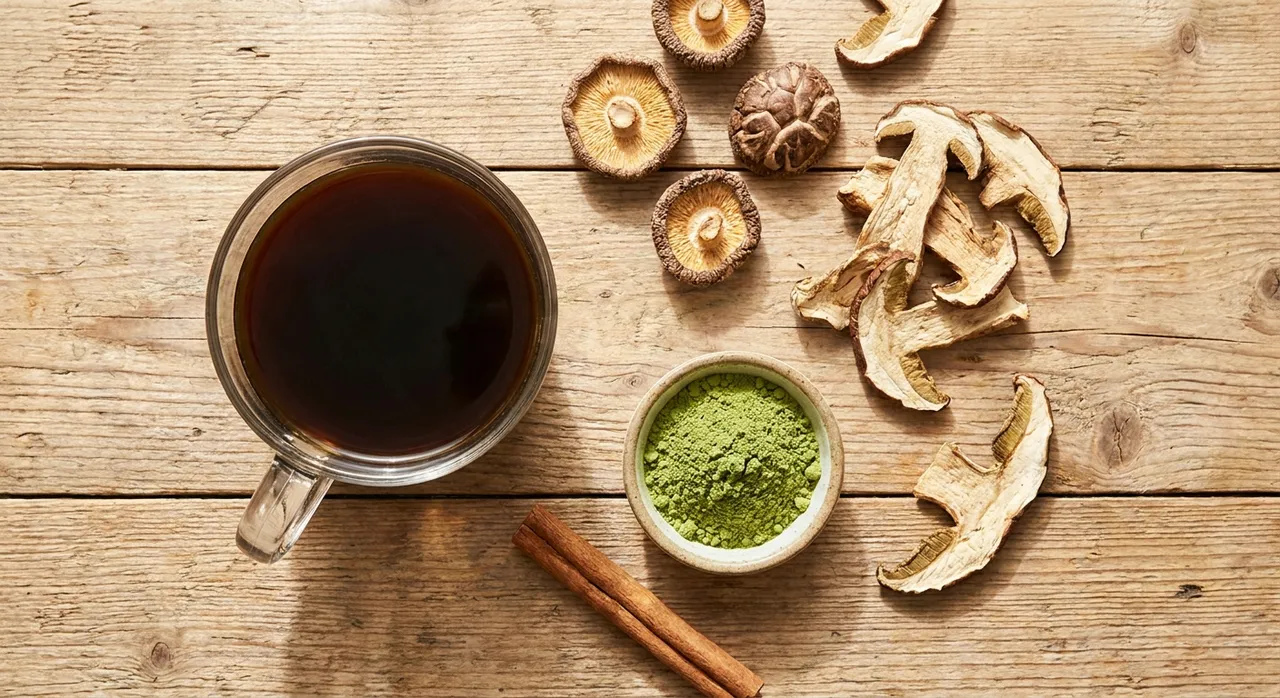
- Cordyceps — this mushroom contains cordycepin and polysaccharides that may support cellular energy by improving ATP synthesis and oxygen utilization. In a double-blind, placebo-controlled trial titled Cordyceps sinensis improves exercise performance in healthy older subjects, it supported exercise tolerance — energy from the mitochondria, not from an adrenaline spike.
- Maca root and ginseng — traditional adaptogens most people reach for to feel steady rather than spiked.
- Chaga and shiitake — beta-glucan mushrooms studied mostly for immune support. In a trial titled Consuming Lentinula edodes (Shiitake) Mushrooms Daily Improves Human Immunity, daily shiitake supported immune markers in healthy young adults.
- Turmeric, ginger, cinnamon, and cocoa — the anti-inflammatory, blood-sugar-friendly, genuinely-tasty end of the blend. Curcumin from turmeric even crosses the blood-brain barrier; the trial Memory and Brain Amyloid and Tau Effects of a Bioavailable Form of Curcumin in Non-Demented Adults looked at its cognitive effects over 18 months.
None of these are stimulants in the caffeine sense. They're why the cup can feel like sustained clarity rather than a countdown to a crash.

How I actually use it to avoid the shakes
The blend does a lot, but habits matter just as much. My honest routine:
- Eat something first. Even a few bites of protein. Caffeine on an empty stomach is the fastest route to jittery.
- Use one level scoop in about 8–10 oz of hot water. Resist the double-scoop-for-double-energy logic — that's the adrenaline pathway talking.
- Then wait ten minutes before deciding you need more. Real energy has a lag. Impatience is what leads to over-caffeinating.
- Keep the last cup before early afternoon if you're a slow metabolizer (see the genetics above).
A few reviewers describe the payoff better than I can.
"Never a crash feeling like coffee."Another told us,
"My only regret is that I did not do this sooner."I'd temper the enthusiasm with a dietitian's realism: this won't override a bad night's sleep or a five-cup habit. But swap a jittery routine for a steadier one and the difference is easy to feel by mid-morning.
The honest bottom line
Energy without jitters isn't magic and it isn't a marketing slogan you have to squint at. It's chemistry: modest caffeine, paired with L-theanine to steady attention, and chlorogenic acid to soften the blood-sugar swing, with adaptogenic mushrooms and herbs carrying part of the load so you're not leaning entirely on the adrenaline pathway. That combination is exactly what we built Amazing Coffee around — and it's why I stopped white-knuckling my spoon at 10 a.m.
These statements have not been evaluated by the Food and Drug Administration. This product is not intended to diagnose, treat, cure, or prevent any disease. The studies referenced above describe the individual ingredients and their compounds, not the finished product, and individual results vary. Caffeine sensitivity differs from person to person; if you are pregnant, nursing, taking medication, or have a health condition, talk with your healthcare provider before making changes to your routine.
Priya is a registered dietitian who reviews the science behind every ingredient we use. She spends her days turning clinical research into plain English.
Ready to try it for yourself?
Shop Superfoods Company